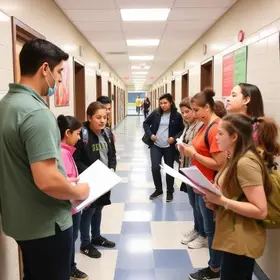
- The Baltimore City College (BCC), also referred to as The Castle on the Hill, historically The College, and most commonly City, is a public college-preparatory magnet school in Baltimore, Maryland, U.S. Despite its name, the school is not a college, i.e. an institution of higher education, as it lacks the authority to confer bachelor's degrees. The City College curriculum includes the International Baccalaureate Programme and emphasizes study in the classics and liberal arts. Admission to City College is competitive. Applicants from Baltimore and the surrounding area are evaluated using a combination of grades and standardized test scores.
- Established in 1839 as an all-male institution, City College is the third oldest public high school in the United States, predated by the English High School of Boston (1829) and the Central High School of Philadelphia (1836). The school was located in three different buildings in downtown Baltimore before relocating in 1928 to its current 38-acre (153,781 m²) campus at 33rd Street and The Alameda in the Waverly neighborhood of north Baltimore. Following an extensive renovation of the school's main building in 1978, the school became coeducational.
- City College has maintained a strong academic tradition and has many notable alumni including a Nobel Laureate, a Wolf Prize recipient, Pulitzer Prize winners, and leaders in business, military, and state and national politics. City College is a National Blue Ribbon School of Excellence (1999–2000), one of only two public secondary schools in Baltimore City to receive the award, a Maryland Blue Ribbon High School, a Maryland Character Education High School of the Year (1999) and a National Association of Secondary School Principals (NASSP) Breakthrough High School (2003). In the May 2007 Newsweek report on the top 1200 schools in the US, City College ranked 258. The previous year the school was ranked 206. A long-standing athletic rivalry exists between City College and Baltimore Polytechnic Institute, though centered around the annual City–Poly football game, the rivalry extends to other sports as well as academics.
- History
-
The creation of a male high school "in which the higher branches of English and classical literature only should be taught", was authorized unanimously by the City Council of Baltimore, Maryland on March 7, 1839. Accordingly, a building on what was then Courtland Street (now Preston Gardens at St. Paul Place) was acquired to serve as the new high school. The school opened it doors on October 20, 1839 with 46 students and 1 teacher, Nathan C. Brooks. The school was housed in three different locations in its first three years of existence before returning to the original building on Courtland Street. Finally, in 1843 the city council allocated $23,000 to acquire the Assembly Rooms at the northwestern corner of Fayette and Holliday Streets for the school. In 1850, the city council granted the board of school commissioners the right to confer graduates of the school with certificates, and the following year the school held its first commencement ceremony in 1851.
- In 1865, in accordance with a recommendation from the Board of Commissioners of the Baltimore City public schools, the school began offering a five-year track, as part of a process aimed at elevating the school to the status of a college so that it could grant its graduates baccalaureate degrees. The following year on October 9, 1866, as another part of this process, the school was renamed "The Baltimore City College" (BCC) by act of the city council. The city council failed to take any further action, and although the school changed nominally, it was never granted the power to confer Bachelor of Arts degrees.
- The building on Fayette and Holliday Streets had been in a state of decline for two decades. It was not until 1873, when a fire spread from the Holliday Street Theater to the "Assembly Rooms", that the city council finally decided to expend the resources to erect a building for City College. A lot was acquired on Howard Street opposite Centre Street and the city council allocated $150,000 for the construction of the new building. The new English Gothic revival-styled building was dedicated on February 1, 1875 and the school moved in the following week.
- thumb|left|Baltimore City College, 2010
- The Tudor Gothic building which housed the school lasted until 1892, when it was undermined by the construction of the Baltimore & Ohio Railroad tunnel from Camden Station to Mount Royal Station and collapsed. In 1895, a new structure, designed by the architects Baldwin and Pennington, was erected on the site. This new building quickly became overcrowded and an annex was established on 26th Street. The addition did not help with the increase in school-aged youth beginning to attend City College by World War I. During the 1920s, alumni began a campaign to provide the school with a more suitable building, and in 1926 ground was broken for a massive Collegiate Gothic stone castle at 33rd Street and The Alameda. This new structure cost almost $3 million.
- The school began admitting African-American students following the landmark ruling Brown v. Board of Education. In September 1954, entered City College. The administration also sent two African-American men, Eugene Parker and Pierre Davis, to teach at school in 1956. Parker taught at City College for 30 years and Davis, after teaching for one year, returned as the school's first black principal in 1971.
- In 1978, at the urging of concerned alumni, City College under went its first major capital renovations. When the campus reopened, the high school welcomed women for the first time. The all-male tradition did not end easily; alumni had argued for the uniqueness of a single-sex educational system and convinced the task force studying the issue to vote 11–6 in favor of keeping the all-male tradition. The Board of School Commissioners, in a reversal, voted to admit women citing constitutional concerns.
- Campus
-
- City College stands on a 38-acre (153,781 m²) campus in northeast Baltimore at the intersection of 33rd street and the Alameda. The campus consists of two buildings, the Gothic-style edifice known locally as the "Castle on the Hill" that sits in the center of the campus, and the power plant building east of the castle. In addition to providing the building's utilities, the power plant originally housed five work shops: an electrical shop, a mechanical shop, a metal shop, a printing shop, and a wood shop. Only the main building is in academic use by the school. Both buildings were designed by the architecture firm of Buckler and Fenhagen. Just south of the main building is Alumni Field, the school's stadium, which serves as home to the football, boy's and girl's lacrosse and track teams. During a major building renovation in 1978 a modern gymnasium was added to the southwest corner of the main building.thumb|rightOn June 30, 2003, the current building was placed on the National Register of Historic Places as the result of an Alumni Association initiative. The listing of the building coincided with its 75th anniversary. The previous location of the school on Howard Street is also listed on the National Register of Historic Places. On April 24, 2007 the Castle on the Hill earned the additional distinction of being a Baltimore City Landmark. This new status means that the building’s exterior cannot be altered without approval of the city Commission for Historical and Architectural Preservation.On June 21, 2007, City's alumni association received a historic preservation award from Baltimore Heritage for its leadership role in preserving the building as an historic Baltimore landmark.
- Academics
-
Throughout most of the 20th century the college preparatory curriculum at City College was divided into two tracks: the "A" course and the "B" course. Though both tracks were intended to provide students with the skills necessary for college, the "A" course was intended to be more rigorous. In the early 1990s, Principal Joseph Antenson removed the two tier system because he believed it to be racially discriminatory. In 1998, the academic program took on the general form in which it exists today, when Principal Joseph M. Wilson introduced the International Baccalaureate Diploma Program (IB Program) into the 11th and 12th grade curricula. The IB Program is a comprehensive, liberal arts program that must be completed in students’ junior and senior years. Students now have the option to pursue a standard college preparatory curriculum, the IB Program, or a combination of the two.
- In 2007, opposition to the continuation of the IB Program arose. Members of the Baltimore City College Alumni Association argued that the IB Program was diverting a significant amount of the school's resources, in order to benefit a fraction of the student population. Only approximately 30 students are in the full IB Diploma Program at City College. Some members also argued that the rigidity of the program did not give students enough flexibility. Citing these concerns, the alumni association encouraged the school to replace the IB Program with the "A course" and expand the number of Advanced Placement courses offered. The expansion of the number of AP and IB courses offered allowed City to perform well in the Newsweek rankings, which are based heavily on the number of AP and IB courses offered.
- Enrollment
-
Students wishing to enroll in City College must apply in the 8th grade. Enrollment is open to both residents and non-residents of Baltimore City, though non-residents must pay tuition. Eligibility is based on a composite score that is determined by the Baltimore City Public School System. The school system generates the composite score based on a student's grades in the 7th grade and first quarter of the 8th grade, and a student's performance on a national standardized test, with the student's grades receiving double the weight as the test scores.
- The enrollment at City College in 2007 was 1353 students. Of those students, 504 were males representing approximately 37.25% of the student populations, and the remaining 849 students were females, representing approximately 62.75% of the student population. The 1229 students who identified themselves as African-American comprised 90.84% of the student population. An additional 105 students identified themselves as white, comprising 7.76% of the student population. The remaining 1.4% of the population identified themselves as Hispanic, Asian, or American Indian.
- Extracurricular activities
-
City College offers more than 20 student clubs and organizations. These activities include chapters of national organizations such as National Honor Society (established at City in 1927) and Quill and Scroll. City College offers service clubs such as the Red Cross Club and Campus Improvement Association.
- Bancroft and Carrollton-Wight Literary Societies
-
The origins of the speech and debate program at City College lie in the Bancroft Literary Association, which was established in 1876. In 2006, City College defeated the 2005 State Champion Squad from Richard Montgomery High School to advance to the semifinals of state championship, but was later defeated by local rival the Park School of Baltimore, which advanced to the final trial.
- Band
-
The marching band at City College was created in the late 1940s. At the time, the instrumental music program consisted of the orchestra, concert band and marching band. The director who brought the band to prominence was Dr. Donald Norton. In 1954, while on sabbatical, he was replaced by Professor Charles M. Stengstacke. The 65 member concert band doubled as a marching band in the fall. During halftime performances at home the band would form the shape of a heart or a car, but always ending the performance by forming the letters C-I-T-Y.
- In the 1980s, under James Russell Perkins, these groups grew in size and changed styles, adding "soulful" dance steps. Perkins’s groups toured and traveled the east coast. They received superior ratings at district and state festivals. Perkins is responsible for the creation of the City College Jazz Band, the “Knights of Jazz”.
- In 1994, Alvin T. Wallace became Band Director. During his tenure, a wind ensemble was added and the marching band grew to include over 150 members. In 1999, the band swept the top categories in the Disney World high school band competition. In 2006, the wind ensemble received a grade of superior at the district adjudication festival and marched in the Baltimore Mayor's Christmas Day Parade.
- Choir
-
The City College choir was founded in 1950 by Professor Donald Regier. Originally a co-curricular subject with only 18 members, by 1954 it had developed into a major subject of study with 74 students enrolled.Under the direction of Linda Hall, today's choir consists of four groups: the Mixed Chorus, the Concert Choir, the Singin'/Swingin' Knights, and the Knights and Daze Show Choir.
- On October 2, 2007, the Weill Institute of Music at Carnegie Hall announced that the City College choir was one of four high school choirs selected to participate in the National High School Choral Festival on March 10, 2008. The four choirs will perform Johannes Brahms' A German Requiem under the direction of Craig Jessop, Mormon Tabernacle Choir Director. The choirs will also be led by their own directors in performing choral selections of their choosing.
- Athletics
-
thumb|upright|Girl's basketball, championship game vs. Hill High School|River Hill (in blue & white), March, 2009]During the late 1880s, inter-scholastic sports became a feature of school life and a number of teams were begun in various sports. The formal organization of an athletic program did not occur until 1895. During the early years of the athletic program, City College played mainly against college teams because few other secondary schools existed in Maryland. The 1895 football schedule included St. John's College, Swarthmore College, the United States Naval Academy, University of Maryland, and Washington College.The current City College athletic program consists of six boy's varsity teams, seven girl's varsity teams, and five coeducational teams. The boy's sports played are baseball, basketball, football, lacrosse, soccer, and wrestling. The girl's teams are badminton, basketball, lacrosse, soccer, softball, volleyball. The five co-ed teams are cross country running, indoor track and field, swimming, track and field, and tennis. Although much of City's athletic history involves boys sports, it was the girl's basketball team that won City's first state championship in 2009. Four hours later, City's boys basketball team won the Maryland Class 2A championship, beating Douglass(PG) at the Comcast Center.
- Football
-
The football program began in the 1880s, yet at the time the school faced mainly collegiate opponents, since few other schools in the area fielded teams.
- City–Poly football rivalry
-
The City–Poly football rivalry is the oldest American football rivalry in Maryland, and one of the oldest public school football rivalries in the U.S. Former Baltimore Mayor Kurt Schmoke was the quarterback and Maryland Delegate Curt Anderson was the captain of that team. The game is no longer played on Thanksgiving or at Memorial Stadium, but is now located at the home of the Baltimore Ravens, M&T Bank Stadium, in downtown Baltimore. With 2007's 26–20 win by City, Poly leads the series 58–54–6 (counting the first 15 scrimmages won by City).
- Lacrosse
-
The lacrosse program at City College is the oldest high school lacrosse program in the state of Maryland. The informal playing of lacrosse began at the school in 1879, when a group of students decided to field a team; this continued annually until 1891. At least 10 former members of the men's lacrosse team are in the National Lacrosse Hall of Fame. Currently, both men's and women's lacrosse are played at City.
- Student publications
- The Green Bag
-
The Green Bag is the senior class annual at City College. Published continuously since 1896, The Green Bag is the oldest publication still in existence at the school. G. Warfield Hobbs Jr., president of the 1896 senior class and first editor-in-chief of the Green Bag, gave the publication its name in recognition of the role of City College graduates in political leadership. Historically, the political appointees of the Governor of Maryland have been known as the "green bag", though the derivation of the term is unknown. The first yearbooks contained sketches of faculty and seniors, and included recollections, anecdotes, stories, and quotes significant to the student body. Underclassmen were included for the first time in 1948. In 2007, The Green Bag released its first full-color edition.
- The most controversial issue of the Green Bag was published in 1900 when Members of the senior class used the annual to make fun of their professors. The school board attempted to censor the edition by requiring the Green Bag to be reviewed by Principal Francis Soper. The yearbook had already been printed, and in defiance of the school board, the editors refused to have the edition censored and reprinted. The school board responded by withholding the diplomas of six of the editors and the business manager and by preventing the school from holding a public commencement ceremony. One of the boys expelled, Clarence Keating Bowie, became a member of the school board in 1926.
- The Collegian
-
The Collegian has been the school newspaper of City College since its first publication as a bi-weekly newspaper in 1929. In recent years, the publication has waned. Budget cuts have reduced the number of issues printed. Citing the decline of The Collegian and increasing disorder in the school, several students started an underground publication entitled Omnibus in May 2007.
- Alumni Association
-
The Baltimore City College Alumni Association Inc.(BCCAA) was established in 1866 as a support network for City College. The BCCAA holds an annual meeting at the school every November and its Board of Governors meets the first Monday of each month at the school.
The BCCAA publishes the class reunion guide, established and maintains a life membership endowment fund, presents Golden Apple Award annually to faculty members, sponsors the Hall of Fame selection and induction, publishes a semi-annual newsletter, maintains an alumni data base and assists with numerous projects designed to enrich student life and improve the facility.
- Trustees of the Baltimore City College Scholarship Funds
-
To succeed a similar organization which was established in 1924, the Trustees of the Baltimore City College Scholarship Funds, Inc., was established and incorporated in 1983. The Trustees manage numerous endowments, most of which provide annual scholarships to graduating seniors based on criteria stipulated by the donors. Combined endowment assets are currently valued at or around $1,500,000 covering 34 annual scholarships. To recognize the custodianship provided by the Trustees, the BCCAA has placed a bronze plaque in the main hall of the school which carries an individually cast nameplate for each of the 34 permanent endowments held by the Trustees.
- Baltimore City College Hall of Fame
-
The Baltimore City College Hall of Fame induction ceremony is held every October. Alumni who have demonstrated extraordinary service to the school, the city, state, country or the world are selected to become members with former inductees, alumni and students attending the two-hour ceremony. One of the 2007 inductees was Robert Hormats, uh Vice-President at Goldman Sachs.
- Notable alumni
-
Many City College alumni have become civil servants, including three of the 10 individuals currently representing the state of Maryland in the U.S. Congress—Congressman Elijah Cummings, Congressman Dutch Ruppersberger, and Senator Ben Cardin. namesake and co-founder of Abercrombie & Fitch.
- Notable faculty members
- Blanche F. Bowlsbey, first female teacher (1935–1955)
- Ed Burns, Edgar Award-winning writer for The Corner and The Wire
- McFadden Newell, first principal, Towson University
- ZZ Packer, author, Guggenheim Fellow
- Pierre Davis, first African-American teacher (1956), first African-American principal (1971)
- Eugene Parker, first African-American coach (1956–1986)
- George Petrides, longest serving faculty member (1972–present)
- Mellasenah Morris, Dean, Peabody Institute of the Johns Hopkins University (2008–present)
- George L.P. Radcliffe, U.S. Senator
- Henry E. Shepherd, superintendent, Baltimore City Public Schools; president, The College of Charleston (1882–1897)
- Robert Herring Wright, first president, East Carolina University
- George Young, NFL Executive, General Manager New York Giants
- Principals
- Dr. Nathan C. Brooks (1839–1849), first principal
- Rev. Dr. Francis G. Waters (1849–1853), President, Washington College
- Francis A. Soper (1890–1911), longest serving principal
- Dr. Wilbur F. Smith (1911–1926), first Chancellor, University of Baltimore (1926–1933)
- Dr. Pierre A. Davis (1970–1974), first African-American principal
- Jean Johnson (1988–1990), (1992–1994), first female principal
- Notes
- External links
- Baltimore City College website
- Baltimore City College Alumni Association (BCCAA)
- Baltimore City College PTSA
- Maryland Report Card - Baltimore City College
- Abell Programs: BCC Speech and Debate Program
- Baltimore City College on Google Street View
- Source: Wikipedia; it is used under the GNU Free Documentation License. You may redistribute it, verbatim or modified, providing that you comply with the terms of the GFDL.
-
Add/edit information about this school (e.g., awards, news stories, notable alumni, fun facts)
|