Bronx High School Of Science School
75 West 205th Street, Bronx, NY, 10468 -  Map
School Overview:
Definition of Terms
Bronx High School Of Science School
School Level High school
Grades Offered Grades 9 - 12
County Bronx County, NY
Students & Faculty
Total Students 2436 students
% Male / % Female 55%  /  45%
Total Classroom Teachers 112 teachers
Students by Grade
Grade 9 - 640 students
Grade 10 - 631 students
Grade 11 - 572 students
Grade 12 - 593 students
This School
(NY) School Average
Teacher : Student Ratio 1:22 1:14
Students by Ethnicity
This School
(NY) School Average
% American Indian n/a n/a
% Asian 60% 6%
% Hispanic 6% 17%
% Black 5% 19%
% White 28% 55%
% Unknown 1 % 3%
Additional Student Information
This School
(NY) School Average
% Eligible for Free Lunch 23% 28%
% Eligible for Reduced Lunch 10% 6%
% Migrant Students Enrolled n/a n/a
School Performance:
(NY) Statewide Testing Performance
School Statewide Performance View Education Department Test Scores
School District:
School District Name New York City Public s School District
This School's Agency
(NY) District Average
Number of Schools Managed 78 4
Number of Students Managed 55,238 students 2,265 students
District Total Revenue n/a $31,819,000
District Expenditure n/a $31,869,000
District Revenue / Student n/a $14,048
District Expenditure / Student n/a $14,070
District Graduation Rates n/a 97%
School Notes:
  • The Bronx High School of Science, commonly called Bronx Science, or just Science, is a specialized New York City public high school located in the Bedford Park section of the Bronx, with no tuition charges and admission by exam. Since its founding in 1938 with a traditional focus on mathematics and science, Bronx Science has developed a worldwide reputation as one of the best high schools in the United States, public or private. It attracts an intellectually gifted blend of culturally, ethnically, and economically diverse students from New York City.
  • Together with Stuyvesant High School and Brooklyn Technical High School, Bronx Science is one of three original specialized science high schools operated by the New York City Department of Education. Admission to these schools is by competitive examination only, and only residents of the City of New York are eligible to attend.
  • It is a member of the NCSSSMST. Almost 100% of Bronx Science graduates go on to four-year colleges; many attend Ivy League and other highly selective schools. Bronx Science counts 125 finalists in the prestigious Intel Science Talent Search (formerly Westinghouse), the largest number of any high school. Seven Nobel Prize-winning scientists and five Pulitzer Prize-winning writers are also among the many notable Bronx Science graduates.
  • History: The Bronx High School of Science was founded in 1938 as a specialized science and math high school for boys, by resolution of the Board of Education of the City of New York, with Dr. Morris Meister as the first principal and guiding light of the school. They were given use of an antiquated Gothic-gargoyled edifice located at Creston Avenue and 184th Street. The building, built in 1918 for Evander Childs High School, had been successively occupied by Walton High School (1930) and by an annex of DeWitt Clinton High School (1935). The initial faculty were in part comprised by a contingent from Stuyvesant High School. Dr. Meister put his imprint on the school from its formation, for example selecting as school colors "green to represent chlorophyll and gold the sun, both of which are essential to the chain of life".
  • Expansion to co-education: Bronx Science started with about 150 ninth year students and 250 tenth year students, the remaining facilities of the building being used by DeWitt Clinton. As Science became larger, the Clinton contingent was gradually returned to its own main building. During their joint occupation, which lasted for 2 years, until 1940, the two schools had separate teaching staff and classes, but the same supervision and administration.
  • In the year 1946, as a result of the efforts of Dr. Meister, the faculty, and the Parents Association, the school became co-ed, preceding its rival schools Stuyvesant (1969) by 23 years, and Brooklyn Tech (1972) by 26 years. This opened the doors to gifted and talented girls of New York, giving them equal opportunity to pursue a quality education in a specialized high school, previously denied to them.
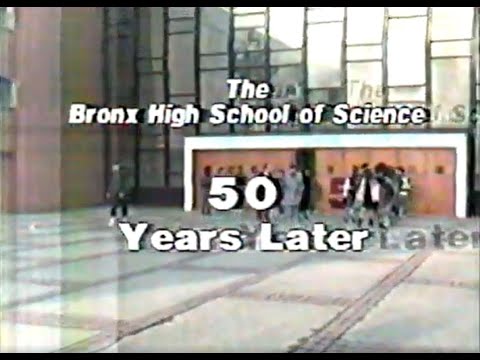
  • The move to modern facilities: From the very beginning, a campaign for a new building was conducted by the Parents Association, and sparked by the tireless dedication of Dr. Meister. Working with the Board of Education and the City of New York took twenty years to see the dream become a reality, but under Dr. Taffel's guidance, plans were finally completed for a new building, specifically designed and equipped for the Bronx High School of Science. The new building would be on 205th Street near Bedford Park Boulevard, in a predominantly institutional region commonly referred to as the "Educational Mile" between DeWitt Clinton High School and its large football field on one side, and Harris Field and Hunter College (now Lehman College) on the other. On March 3, 1959, students and faculty occupied the new building for the first time, solving the problem of how to move the books from the old library to the new in typical Bronx Science manner: on Friday afternoon each student took home five library books from the old building, and on Monday returned them to the new one.
  • They entered a school equipped with the most modern facilities and state-of-the-art laboratories, classrooms, and technical studio areas, all designed to the specific needs of the specialized Bronx Science curriculum. Gracing the main lobby entrance was a large, 63-foot, Venetian glass mosaic mural depicting major figures from the history of science such as Marie Curie and Charles Darwin under the protective hands of a God-like figure representing knowledge, with this quote from John Dewey: "Every great advance in science has issued from a new audacity of imagination". The mural is an original work of art by Frank Reilly entitled Humanities Protecting Biology, Physics, Chemistry, reflecting the breadth of the school's mission: to excel not only in the sciences and mathematics for which it was founded, but also in the humanities. Legions of students over the years, bemoaning the lack of swimming facilities, have sarcastically referred to the mural as "the Science swimming pool", perpetuating the idea - perhaps apochryphal - that a choice was made to fund a mural rather than a pool in the new building; but the mural continues to epitomize the special nature of the Bronx High School of Science.
  • When Bronx Science celebrated its silver anniversary in June 1963, President Kennedy hailed it as "a significant and pathfinding example of a special program devoted to the development of the student gifted in science and mathematics." The President had occasion to know the quality of the school's product since he had recently selected one of its graduates, Dr. Harold Brown, of the class of 1943, for the position of Director of Defense Research and Engineering; he'd later serve as Secretary of Defense under President Carter.
  • Stuart S. Elenko Holocaust Museum and Studies Center: In 1978, a popular Social Studies faculty member, Stuart Elenko, founded a Holocaust Museum and Studies Center at Bronx Science practically single-handedly. It has been funded by grants, donations, and the New York City Council. The Museum was one of the first of its kind in the United States, and houses an impressive collection of rare documents, photographs, artifacts and other material from the Nazi era; the Studies Center sponsors speakers and puts together and distributes educational materials about the Holocaust. The Museum has had over 60,000 visitors, and has received wide acclaim from leaders in the field. In 2004 an anonymous benefactor - an alumnus of the school - made a very large donation which is allowing the Museum to modernize and be totally revamped; eventually it will move out of the Library where it now resides, and turn into a full-sized Museum.
  • Recent administration: When Dr. Taffel retired in 1979, the chairman of the Biological Science Department, Dr. Milton Kopelman, became Principal. He remained so for over ten years.
  • In 2000 William Stark, a popular Assistant Principal of the Social Studies Department, was appointed Acting Principal. He was expected to move up to the Principal's office, when Chancellor Harold O. Levy decided to try to find a Nobel laureate to become Principal; that effort failed, and before being offered the job as Science's Principal, Stark accepted a job as Principal of Manhasset High School. Many faculty and parents were upset that Stark was not appointed in a timely way and thus had left the school; Vincent Galasso agreed to step up again, for one term, in 2001.
  • Although not a popular choice, Valerie J. Reidy, Assistant Principal of the Biology department, was appointed Principal in September 2001; she is the first woman Principal in the school's history. Despite that distinction, she has been a controversial figure.
  • Facilities and resources: Computerized & renovated science laboratories, including the Syracuse University @ Bronx Science Crime Lab and DNA Research Lab.
  • Television studio, Computer laboratories, Weather Station, Rooftop planetarium, High speed internet access in every room, Televisions equipped with DVD/VHS players in every room.
  • The Bronx Science Library is committed to supporting the student body by providing extensive resources ranging from traditional print and microform to electronic subscription e-journals and databases rivaling many higher institutions. Located on the first floor just off the main lobby, the library is composed of three smaller rooms encompassing approximately 65, 000 square feet with a seating capacity of 100. Holdings include over 30,000 volumes, 135 different magazines, microforms (including the New York Times on microfilm dating back to 1851) and readers, and computers in the computer room. Every available space is productively used, and presents a comfortable and attractive environment for students who use the library for study, relaxation, and computer activities.
  • Especially notable among its electronic resources is ScienceDirect, a free science journal service by Elsevier to a select few science high schools. It is used by students in their own original research endeavors as a gateway to firsthand experience with published scientific research. The library currently also holds the renowned Holocaust Museum and Studies Center.
  • Academics: Bronx Science students take a rigorous, well-rounded, college preparatory curriculum that includes four years of life science (biology) and physical science (chemistry/physics), math, English, foreign language, social studies, and fine arts, with required courses and a wide selection of electives, including AP classes. Over 600 classes are offered. Students have an opportunity to do independent research, and many compete in the annual Intel Science Talent Search (formerly known as "Westinghouse"). After the completion of four years at Bronx Science, and the fulfillment of the Bronx Science academic track, students graduate with a Bronx Science degree - more advanced and more prestigious than a typical New York State Regents Degree.
  • The basic science courses chosen are typically earth sciences, biology, chemistry, and physics; many students choose to take the Advanced Placement version of these courses, which allows for students to place out of introductory science courses in college. In the life sciences, the students have the additional option of taking a special "double honors" biology course, which features extra laboratory exposure. Science electives include microbiology, physiology, forensic science, human genetics, evolution, astronomy, organic chemistry, electronics and others.
  • In mathematics, beyond the standard AP courses in AB/BC calculus and statistics, courses in multivariate calculus, probability and statistical inference, and computer science courses are among the choices.
  • Students take four years of English, which also allows for electives, including courses in journalism, Shakespeare, creative writing and AP English.
  • Social studies and history classes are required, and include US and world history, economics, with electives in psychology, law, finance, and global studies, among others.
  • Three years of languages are required. Bronx Science offers French, Spanish, Latin, Russian, Italian, Modern Greek, Chinese, Japanese, and Korean. At one time Hebrew was also offered.
  • Students are required to take Technical Drawing (formerly known as Mechanical Drawing) and a Science Techniques Laboratory course; technology courses include engineering and architectural drawing, telescope making, computerized graphics, robotics technology, and medical illustration. Art and Music Appreciation are also required courses, with a range of studio art electives and music performance electives available.
  • Health and Physical Education courses are also required, with many activities to choose from.
  • Academic teams: Speech and Debate Team, Ocean Sciences Bowl Team, for the National Ocean Sciences Bowl competition.
  • Moot Court Team, that competes in the New York City Bar Association's Moot Court Competition.
  • Mock Trials Team.
  • Publications: Science Survey is Bronx Science's entirely student-run newspaper. Students manage everything from reporting, layout, design, editing and final production. The paper is distributed 5 times per year, gratis. Survey has been the name of the Bronx Science student newspaper since the founding of the school in 1938.
  • Math Bulletin is the annual publication of the Bronx Science Mathematics Department. Student term-papers, original student mathematics research, and interesting topics in Mathematics are featured.
  • Reactions is a school publication written by Physical Science students.
  • Dynamo is the literary magazine of the Bronx Science English Department. The entire student body is encouraged to submit original poems and other works which are considered for publication.
  • Bronx Science publishes a Biology Journal annually. It is a joint venture between students and the faculty of the Biology Department to document advances in the field of Biology, both within Bronx Science and in the outside world. Each themed issue contains interviews, commentaries, artwork, featured student research papers and abstracts from every student Biology research project that year (See Research).
  • Exposition is an annual production of the Bronx Science Social Studies Department.
  • Extra-curricular activities: Baseball: Boys, J.V. & Varsity; Basketball: Boys & Girls, J.V. & Varsity; Bowling: Co-ed, Varsity; Crew: Co-ed, Varsity; Cross Country: Boys & Girls, Varsity; Fencing: Coed, Varsity; Golf: Boys & Girls, Varsity; Gymnastics: Boys & Girls, Varsity; Handball: Boys & Girls, Varsity; Indoor and Outdoor Track: Boys & Girls, Varsity; Soccer: Boys & Girls, Varsity; Softball: Girls, J.V. & Varsity; Swimming: Boys & Girls, Varsity; Volleyball: Boys & Girls, J.V. & Varsity.
  • Clubs: A Capella, Amnesty International, Animal Room Squad, ARISTA Honor Society, Art & Cartoonists Society, Astronomy Club, Baseball Club, BOSS (Black Org. for Student Strength)/W.I.S, Cartoonists Society, Cheerleading Club, Chess Club, Children's Charity Club, Chinese Students Union, CIAO, Circle of Racial Understanding, College Circle, Computer Technology Society, Cooking Club, Current Events Club, Cyber, Dance Squad, DDR Club, Speech and Debate Team, Defenders of Wildlife, Drama Club, Eastern European Club, Eastern Religion Club, Echobelly (Poetry Workshop), Equestrian Club, ESPN3, Exposition History magazine, FBLA, Fencing Club, Filipino Club, Film Production, Foreign Film Club, Gay-Straight Alliance, German Club, Go Club, Guyanese Club, Gymnastics Club, Health and Fitness Forum, Hellenic Cultural Society, Helping Hands, History Club, Horticulture, Indian Cultural Society, Japanese Animation Club, Judaic Cultural Society, Junior Electrical Engineers, Key Club, Korean Club, La Tour Eiffel, Latin Club, Leadership, LEAP Ecology Club, Lunar New Year Productions, Media Activism Club, Model UN Club, Music Club, Muslim Student Association, Origami and Crafts, Perspectives ~ Outreach, Philosophy Club, Photo Club, Physics, Pre-Med Society, Radio & Space Comm, Random Acts of Kindness, RCF, Reader's Society, Red Cross Club, Rival Magazine, Role Players, Robotics Club, Russian Cultural Society, S.O.S.J., Science Fiction Fantasy, Seekers Club, Simulation Corporation, SING, student produced musical, Soccer Club, Speakers Forum, Stock Market Club, Students Against Violence Everywhere, Symposium, Table Tennis Club, Thai Expo, The Other Box, Tibetan Cultural Society, Ultimate Frisbee, Unidad, Urban Dance Club, Volleyball Club, Weather Club, Web Club, Women's Forum, Woodstock Nation, Young Republican Club.
  • Notable alumni: The Bronx High School of Science counts seven Nobel Prize-winning physicists among its graduates:
  • Leon N. Cooper 1947, Brown University awarded 1972.
  • Sheldon L. Glashow 1950, Boston University, awarded 1979.
  • Steven Weinberg 1950, University of Texas at Austin, awarded 1979.
  • Melvin Schwartz 1949, Columbia University, awarded 1988.
  • Russell A. Hulse 1966, Princeton University, awarded 1993.
  • H. David Politzer 1966, California Institute of Technology, awarded 2004.
  • Roy J. Glauber 1941, Harvard University, awarded 2005.
  • No other secondary school in the world has seven Nobel laureates as alumni. If Bronx Science were a country, it would be tied at 21st for number of Nobel laureates (as of 2006).
  • Bronx Science also has five Pulitzer Prize-winning graduates:.
  • William Sherman 1963, reporter at the New York Daily News, awarded 1974.
  • William Safire 1947, author and columnist at The New York Times, awarded 1978.
  • Joseph Lelyveld 1954, Executive Editor at The New York Times, awarded 1986.
  • Bernard L. Stein 1959, Editor of the Riverdale Press, awarded 1998.
  • William Taubman 1958, Professor of Political Science at Amherst College, awarded 2004.
  • Six alumni have won the National Medal of Science, the nation's highest scientific honor bestowed by the U.S. President and thus far awarded to 425 scientists and engineers. Bronx Science also counts among its graduates twenty-nine current members of the United States National Academy of Sciences (NAS), an honor attained by only about 2,000 American scientists. Twenty-two current members of the United States National Academy of Engineering (NAE) and ten current members of the Institute of Medicine (IOM) are Bronx Science graduates.
  • Source: Wikipedia; it is used under the GNU Free Documentation License. You may redistribute it, verbatim or modified, providing that you comply with the terms of the GFDL
  • Add information about this school (e.g., awards, news stories, notable alumni, fun facts)
 
School Zip Code:
About This Zip Code (10468)
School Zip (10468)
(NY) State Average
Population (Approximate) 78,309 people 18,208,943 people
% (age 25+) w/College Degree 18% 32%
Population Average Age 29 years old 34 years old
Average Household size 3.0 persons 2.6 persons
Median Household Income $26,852 $41,761
Avg. # of Rooms in Household 3.2 rooms 4.6 rooms
Median Age of Housing Structure 61 years old 56 years old
View current housing listings in this area
Median Value of Housing Unit
Zipcode (10468)


What's a Zindex?
Subject to Zillow Terms of Use
% Owning / % Renting 9% / 91% 42% / 58%
School Map:
1. Marie Curie High School-nursing - 279 students - 0.5 mi. away - view location
2. Walton High School - 3370 students - 0.6 mi. away - view location
3. High School - Teaching And Professions - 2136 students - 0.6 mi. away - view location
4. Kingsbridge International High School - 112 students - 0.6 mi. away - view location
5. Fordham High School Of The Arts - 467 students - 0.6 mi. away - view location
View all schools in: Bronx, Bronx County, Zip 10468 
Tip: Zoom in/out using the slider below. View aerial photos using the Satellite or Hybrid buttons.
Note: Data has been gathered from several government and commercial data sources. School data reflects 2006 statistics (most recent year available).


Add School Reviews Review school: Add School Reviews - Recommended Add School Reviews - Not Recommended
Public School Articles
Bronx High School of Science Pullover Hooded Sweatshirt
$43.99 $39.99

Bronx High School of Science Essential T-Shirt
$19.99

Bronx High School of Science Dri Mesh Short Sleeve
$39.99 $34.99

Bronx High School of Science Champion Cotton Tagless Ringer Tee
$23.99

Bronx High School of Science Champion Double Dry Shorts with Piping
$27.99

Bronx High School of Science Embroidered Colorblock Sport Duffel
$36.99 $32.99

Bronx High School of Science Embroidered Low Profile Cap
$21.99 $19.99
Update mascot and colors