Strive Secondary ranks in the bottom 50% of all schools in Minnesota for overall test scores (math proficiency is top 50%, and reading proficiency is bottom 50%).
The percentage of students achieving proficiency in math was ≥50% (which was lower than the Minnesota state average of 56%). The percentage of students achieving proficiency in reading/language arts was ≥50% (which was lower than the Minnesota state average of 59%).
School Overview
School Type
Grades Offered
Grades 1-12
Total Students (19-20)
19 students
Total Classroom Teachers (19-20)
5 teachers
School Rankings
Math Test Scores (% Proficient)
(18-19)≥50%
56%
Reading/Language Arts Test Scores (% Proficient)
(18-19)≥50%
59%
Student-Teacher Ratio
n/a
13:1
American Indian
(19-20)n/a
2%
Asian
(19-20)n/a
7%
Hispanic
(19-20)n/a
9%
Black
(19-20)74%
11%
White
(19-20)16%
66%
Hawaiian
(19-20)n/a
n/a
Two or more races
(19-20)10%
5%
Graduation Rate
(12-13)<50%
81%
Eligible for Free Lunch (19-20)
79%
28%
Eligible for Reduced Lunch (14-15)
11%
7%
School Statewide Testing
School District Name
Source: National Center for Education Statistics (NCES), MN Dept. of Education
Frequently Asked Questions
What percent of students have achieved state testing proficiency in math and reading?
≥50% of students have achieved math proficiency (compared to the 56% MN state average), while ≥50% of students have achieved reading proficiency (compared to the 59% MN state average).
What is the graduation rate of Strive Secondary?
The graduation rate of Strive Secondary is 50%, which is lower than the Minnesota state average of 81%.
How many students attend Strive Secondary?
19 students attend Strive Secondary.
What is the racial composition of the student body?
74% of Strive Secondary students are Black, 16% of students are White, and 10% of students are Two or more races.
What grades does Strive Secondary offer ?
Strive Secondary offers enrollment in grades 1-12
What school district is Strive Secondary part of?
Strive Secondary is part of Intermediate School District 287.
Recent Articles

10 Advantages of Public Education in 2026
Discover the top advantages of public education in 2026, from accessibility and diversity to advanced academic programs and student support.

Should My Child Enroll in Honors or General Courses in 2026?
Learn how to decide between honors and general courses in 2026, including GPA impact, college admissions, stress levels, and student readiness.
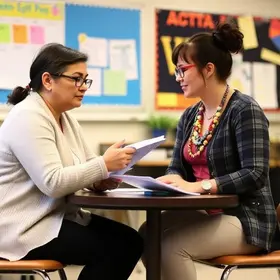
Preparing for Fall Parent-Teacher Conferences
Learn how to prepare for fall parent-teacher conferences with practical tips, key questions, and 2026 communication strategies for families.