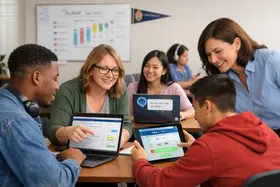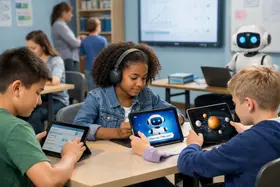
As school leaders experiment with modern educational strategies, one of the most promising programs centers on a concept known as “collaborative reasoning.” Far evolved from the archaic preconceptions of a classroom from the past, collaborative reasoning programs strive to make students active leaders in their learning communities.
Instead of having teachers solely speak and lecture, collaborative reasoning focuses on allowing children to explore using different learning and cognitive development elements. Specifically, as the Educational Psychology Review Journal explores, classrooms centered on collaborative reasoning enable teachers to act as facilitators of small student group discussions and investigations: “Collaborative reasoning discussions are intended to create a forum for children to listen to one another think out loud as they learn to engage in reasoned argumentation.”
Collaborative reasoning is designed to encourage independent critical thinking and question fellow peers and sources. Through this type of proactive learning, experts anticipate that cooperative learning can jumpstart student progress into modernity.
Traditional Learning vs. Collaborative Learning
Hoping to overcome the passive and dull methodologies of inactive classrooms, public schools across the country are embracing efforts to teach students using collaborative reasoning. Examining the need for this reform, Education Week argues, “The least effective mode of teaching and learning is still the most popular at all levels of instruction: teaching by telling, learning by parroting...When you tell it back to me the way I told it to you, I assume you have knowledge.”
Instead of demanding children to listen, memorize, and repeat information using rote cognition skills, many school leaders are shifting classroom instruction towards the values of collaborative learning, thus allowing students to share their own personal experiences, examples, and stories in a critical and conversational dialogue. In doing so, students can speak their ideas, listen to others, and ultimately reach their own supported conclusions. As children navigate this pathway, they are theoretically provided with a more in-depth opportunity for students to analyze their values, as well as others' perspectives.
The Dynamics of a Collaborative Learning Classroom
Teachers often focus on specific learning strategies when incorporating collaborative reasoning principles into a lesson. Specifically, many teachers are striving to utilize collaborative reasoning to help guide students' development in four specific cognitive reasoning properties:
- Teaching students how to read and evaluate a text critically
- Teaching students to use a text to assess and consider multiple possibilities
- Teaching students the value and skills of persuasion
- Teaching children how to control a topic of conversation while sharing turns and respecting each others' idea
This video offers an overview of collaborative learning.
The Benefits of Collaborative Reasoning
To help teachers move away from the inactive methods of lecture and rote memorization, collaborative reasoning programs encourage students to become consistently active and personally accountable for their evaluations and conclusions. As a result, students with “poor” academic records may encounter a new spark of inspiration.
Asthe Foundation for Critical Thinking articulates, in lecture-based classrooms, “The poor student alternates between passive listening and mindless recall, the ‘good’ student between good note-taking and clever cramming. The poor student becomes bored, alienated, or hostile; the ‘good’ student skilled at short-term mimicry.” By setting aside lecture and memorization approaches to learning, school leaders hope kids will learn using a more complex and advanced skill set, forcing students to challenge themselves far beyond the simple methods of note-taking and repetition.
This video offers another explanation of collaborative learning.
Further expounding on the benefits of collaborative learning, the Collaborative Reasoning Research Group, an organization based out of the University of Illinois’ Study of Reading, encourages the practice and implementation of collaborative models based on three fundamental principles about the educational, instructional, and developmental processes. Specifically, the organization argues that collaborative reasoning allows for intellectual stimulation for all students. Secondly, the model fosters individual development through the social constructions of conversation and analysis. Thirdly, such approaches enhance students’ critical literacy skills while boosting comparison and sound reasoning skills.
While some private schools, such as the Waldorf schools, already operate based on collaborative reasoning, the philosophy shows great promise for the future of public school classrooms.
Questions? Contact us on Facebook. @publicschoolreview