This article has been updated to reflect 2026 data and recent developments.
Although a federal court upheld a ban on Mexican-American studies in Tucson Public Schools in 2013, students in the large school district found ways to delve into their own heritage and the history of others who lived in the state. While a judge called the studies “biased, political and emotionally charged,” some Tucson students made it clear they would not let the legal system be the final determinant of what they could learn.
Decision on Mexican-American Studies Goes to Federal Court
AZ Capitol Times reports that a U.S. District Court in Tucson has issued a ruling upholding the state’s decision to do away with Mexican-American studies in the school system. The Tucson Unified School District voted last year to eliminate the curriculum after the state cut funding to the program once it determined the studies were in violation of state law. The law in question prohibited any curriculum taught in public schools that “engendered racial or ethnic disharmony,” according to the Capitol Times.
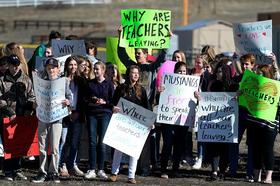
The law does not allow for any curriculum taught in public schools that promotes resentment toward a particular race or is designed primarily for students of a single race or ethnicity. Instead, the state promotes a curriculum that embraces the treatment of individuals, rather than ethnic solidarity. However, students, teachers, and parents protested the decision to do away with the Mexican-American studies last year, asserting the ban was a violation of free speech.
The legal issue made its way to the U.S. District Court, where a federal judge upheld the lower decision to prohibit the curriculum in public schools. Arizona Attorney General Tom Horne, who represented the state in this case, told the Capitol Times, “This is a victory for ensuring that public education is not held captive to radical, political elements and that students treat each other as individuals, not on the basis of the race they were born into.”
Horne had begun his fight against ethnic studies in 2010 when he was superintendent for the state’s Department of Education. At that time, Horne determined the curriculum was in violation of state statutes. His successor superintendent, John Huppenthal, issued a similar determination in 2011, stating the curriculum was in “clear violation” of the statute since it was clearly designed specifically for Latino students.
Decision Sparks “Underground” Studies
While the court decision succeeded in keeping Mexican-American studies out of public school classrooms in Arizona at the time, it did not squelch the interest in the subject by Latino students in the state. In fact, the court decision appeared to fuel the demand for more learning opportunities in this area, according to a report in the Los Angeles Times. Students began looking at new ways to study the subject, from earning college credit while still in high school to visiting “underground” libraries filled with Chicano literature.
The Times reports that Sean Arce, the former head of Mexican-American studies for Tucson schools, is now in high demand to speak at colleges from coast to coast. Arce also told the Times a handful of urban school districts have also expressed interest in bringing him on as a consultant to help them start their own ethnic studies programs. Arce said interest has grown “exponentially” since the ban took effect.
“We are happy and fortunate to collaborate with these folks because it really is a national issue,” Arce said. “It’s because Latinos are the fastest-growing demographic.”
Rachel Velasquez, a student at Prescott College in Arizona, agrees that the ban has sparked more interest in ethnic studies overall. Velasquez, along with 14 other students at Prescott, is now taking a pedagogy course at the college to help them learn to be effective ethnic studies teachers. Velasquez told the Los Angeles Times, “It was only until it was banned that I really took this seriously and recognized the need.”
This video reports on the closure of the ethnic studies program in the Tucson Unified School District.
Despite the ban, some Tucson schools held their annual Cesar Chavez appreciation rally, as they had done in years prior. The Arizona Daily Star reports that Davis Bilingual Elementary Magnet School in Tucson held a weeklong celebration to commemorate the birthday of the Arizona-born civil rights leader, complete with the school’s mariachi band and lessons on social justice and community service.
Other students in Tucson schools needed to look elsewhere to get their fill of Mexican-American studies. One of the teachers at Tucson Magnet High School, Curtis Acosta, had been banned from teaching the subject at his school. However, on Sundays, Acosta offered a course on Chicano literature at the John Valenzuela Community Center in the northern part of the city. Ten students were enrolled in Acosta’s class at the time. Prescott College offered college credit to any student who enrolled in the course. Acosta was also able to raise enough money to offset the cost of the class for students.
This video offers the final report on the ethnic studies closing area.
Some of the students told the Los Angeles Times they liked the Sunday class better than their normal fare of classes during the school week. Bianca Sierra, a senior at University High School in Tucson, told the Times she enjoyed the class because “You can put yourself in their shoes and relate to it more.”
With the ban upheld by a federal court at the time, Sunday classes and underground libraries appeared to be the only way for students to get their fill of the ethnic studies they were missing during the week. While some celebrated the ban, others wondered if it was going too far to strip away at least a portion of the heritage that has made America what it is today.
The legal situation changed significantly after the original article was published. In 2017, a federal judge found that Arizona's ban had been enacted and enforced with discriminatory intent. In December 2017, the court issued an injunction preventing the state from enforcing the restrictions against Tucson's Mexican-American studies program. The decision was covered by Education Week.
By 2026, Tucson Unified School District was offering culturally relevant Mexican-American study courses, including history and literature. These courses are available to students regardless of race or ethnicity. The controversy also remains relevant to broader debates over educational materials, including those discussed in Public School Review's article on banned books in Arizona and Detroit.