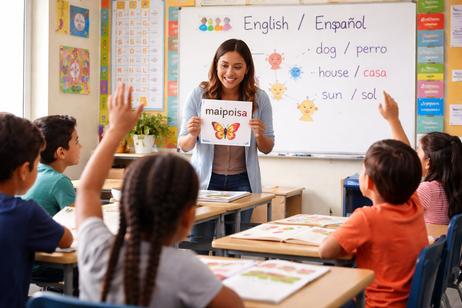
Bilingual education continues to be one of the most debated and dynamic areas of U.S. public education policy. As the nation’s student population becomes more linguistically diverse, families, educators, and policymakers are re-examining how schools can best support bilingual education to meet academic, cultural, and economic goals. This article updates key trends, research findings, policy changes, and real-world examples from the most recent data available in 2025, helping families and decision makers understand the state of bilingual learning today.
What Is Bilingual Education?
Bilingual education refers to instructional approaches in which students learn academic content in two languages, typically English and a partner language, such as Spanish, Mandarin, or American Sign Language. These programs vary widely in design. Some offer support for students learning English, others aim for biliteracy for all students regardless of background, and still others, like dual-language immersion, share instructional time more equitably across languages.
Bilingual education can include:
- Transitional bilingual programs designed primarily to support English learners’ acquisition of English language skills
- Dual-language immersion programs that aim for literacy and academic proficiency in both languages
- Developmental bilingual programs that support heritage language maintenance while students gain English proficiency
A directory of current foreign language immersion offerings illustrates the variety of programs available in U.S. schools, including Spanish-English immersion programs in multiple states. Public School Review
Why Bilingual Education Matters
The push for bilingual education is rooted in research showing a range of academic, cognitive, and social benefits for students.
Academic Benefits: Researchers reviewing decades of studies confirm that bilingual and dual-language programs often yield stronger academic outcomes for English learners compared with English-only programs. These outcomes include better performance in reading, math, science, and social studies over time.
Cognitive and Social Benefits: Students in bilingual settings frequently show enhanced executive functioning, such as improved problem solving and task switching, as well as greater cultural awareness. Some educational reports even suggest that bilingualism may delay signs of cognitive decline later in life.
Family and Community Engagement: High demand for bilingual options is not limited to English learners. Polling from The Century Foundation shows that many U.S. families, especially Latino families in states like California, value bilingual and dual-language programs as avenues to preserve heritage language while achieving English proficiency.
National Demographics and Bilingual Learners
The population of students classified as English learners or emergent bilinguals in U.S. schools has grown steadily over the last decade. Estimates in education research reports show an increase in the share of these students, driven by broader demographic trends. While federal data indicate that roughly 10 percent of public school students are classified as English learners nationwide, the percentage varies widely by state and district.
The linguistic makeup of schools reflects the broader diversity of communities: over 300 languages are spoken by students in U.S. public schools, highlighting the pressing need for programs that support multilingual learners.
Policy Developments Impacting Bilingual Education
Federal Policy
Federal law requires schools to provide language support for students who are not yet proficient in English. However, decisions about how to meet these requirements are largely left to states and local districts. This decentralized policy environment results in significant variation in bilingual offerings from one region to another.
State-level Innovation
Several states have introduced new frameworks and guidance to strengthen bilingual and multilingual learner programs. For example, in 2025 the Connecticut State Board of Education adopted the English Learner and Multilingual Learner Framework, providing voluntary guidance for improving instruction, teacher training, and family engagement for the more than 57,000 English learners in the state. CT Insider
Other states face structural challenges. California has fully restored bilingual education after decades of English-only restrictions, but gaps remain between policy intent and student access to high-quality programs. Only a fraction of English learners in California receive bilingual instruction, in part due to a shortage of qualified bilingual educators and limited funding.
Local Efforts
Districts and individual schools are also expanding offerings. Innovative programs, like early childhood bilingual tracks, are emerging as communities experiment with models that include both English learners and native English speakers. Reports from Midland, Texas, note the launch of a structured dual-language pre-K program that integrates language learning from age three.
Teacher Workforce Challenges
Despite strong demand for bilingual programs, a persistent shortage of qualified bilingual teachers has slowed expansion. Teacher preparation programs in bilingual education have struggled to keep pace with demand, leaving many districts unable to staff dual-language classrooms even when families and leaders express clear interest. This bottleneck is one of the most commonly cited barriers to scaling bilingual offerings nationwide.
Efforts to address this workforce gap include state-level recruitment and certification reforms and partnerships with universities and professional organizations dedicated to preparing bilingual educators.
Parent and Family Perspectives
Family interest in bilingual education remains robust. National polling finds that parents, especially Hispanic parents, often prefer bilingual and dual-language programs over English-only alternatives, citing both academic and cultural reasons. Many families view bilingual education as a way to strengthen connection to heritage language and culture while ensuring English proficiency. The Century Foundation
At the same time, some parents report misconceptions and concerns about bilingual instruction, including fears that learning another language may slow English acquisition. Research evidence consistently shows that high-quality bilingual programs actually support faster and more sustainable English language development for emergent learners.
Real-World Program Examples
Across the U.S., bilingual programs vary widely in scope and size:
- In New Mexico, charter schools like the Sandoval Academy of Bilingual Education offer Spanish-English immersion environments for K-8 students, reflecting local community needs for linguistic and cultural responsiveness.
- Historic bilingual schools such as Coral Way K-8 Center in Miami continue to demonstrate long-term viability of dual-language models, having served students through bilingual instruction since the 1960s.
These examples highlight that bilingual education can operate at different scales and in diverse contexts, from small charter settings to long-established district programs.
Ongoing Challenges and Equity Considerations
Despite strong research support, many bilingual learners still attend English-only programs, and access to dual-language opportunities is uneven across districts. Students in high-need communities and those with disabilities may face additional barriers to meaningful bilingual participation, underscoring the importance of equity-focused policy design. Education Week
Funding limitations also remain a persistent issue. Unlike mandated core academic instruction, bilingual programs often rely on categorical grants or supplemental funding, making them more vulnerable to budget cuts or shifting priorities.
Conclusion
The push for bilingual education in 2025 is propelled by compelling research, growing family demand, and evolving policy frameworks. Evidence shows that bilingual and dual-language programs can support stronger academic outcomes, cognitive development, and cultural engagement for students across backgrounds. However, access remains uneven, and realizing the potential of bilingual education requires sustained investment in teacher preparation, district resources, and policies that prioritize equitable opportunities for all students. As educators and policymakers continue to refine approaches, parents and community leaders should stay informed about program options and research developments that shape the future of bilingual learning.