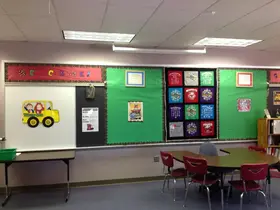
Serving 474 students in grades Kindergarten-5, Highland Elementary School ranks in the top 30% of all schools in Minnesota for overall test scores (math proficiency is top 30%, and reading proficiency is top 30%).
The percentage of students achieving proficiency in math is 52% (which is higher than the Minnesota state average of 46%). The percentage of students achieving proficiency in reading/language arts is 53% (which is higher than the Minnesota state average of 51%).
The student-teacher ratio of 12:1 is lower than the Minnesota state level of 13:1.
Minority enrollment is 43% of the student body (majority Hispanic), which is higher than the Minnesota state average of 40% (majority Black and Hispanic).
Quick Facts (2026)
- Grades: Kindergarten-5
- Enrollment: 474 students
- Student-Teacher Ratio: 12:1
- Minority Enrollment: 43%
- Overall Testing Rank: Top 30% in MN
- Math Proficiency: 52% (Top 30%)
- Reading Proficiency: 53% (Top 50%)
- Science Proficiency: 50-54% (Top 30%)
- Attendance Zone: Highland Elementary serves the entire district of Crookston, MN, with an attendance zone that spans approximately 411.9 square miles. Families can expect a typical drive of 20-30 minutes to reach the school, with the farthest edge of the zone located nearly 19 miles away.
- Source: National Center for Education Statistics (NCES), MN Dept. of Education
School Overview
Highland Elementary School's student population of 474 students has stayed relatively flat over five school years.
The teacher population of 38 teachers has grown by 15% over five school years.
Grades Offered
Grades Kindergarten-5
(No virtual instruction)
Total Students
474 students
Total Classroom Teachers
38 teachers
School Calendar
School Rankings
Highland Elementary School ranks within the top 30% of all 1,773 schools in Minnesota (based off of combined math and reading proficiency testing data).
The diversity score of Highland Elementary School is 0.59, which is less than the diversity score at state average of 0.60. The school's diversity has stayed relatively flat over five school years.
Overall Testing Rank
#519 out of 1773 schools
(Top 30%)
(Top 30%)
Math Test Scores (% Proficient)
52%
46%
Reading/Language Arts Test Scores (% Proficient)
53%
51%
Science Test Scores (% Proficient)
50-54%
41%
Student-Teacher Ratio
12:1
13:1
American Indian
5%
2%
Asian
n/a
7%
Hispanic
29%
12%
Black
4%
12%
White
57%
60%
Hawaiian
n/a
n/a
Two or more races
5%
7%
All Ethnic Groups
Chronically Absent Students
(22-23)20.9%
27.3%
Eligible for Free Lunch
51%
34%
Eligible for Reduced Lunch
7%
7%
School Statewide Testing
School District Name
Source: National Center for Education Statistics (NCES), MN Dept. of Education
Frequently Asked Questions
What is Highland Elementary School's ranking?
Highland Elementary School is ranked #519 out of 1,773 schools, which ranks it among the top 30% of public schools in Minnesota.
What percent of students have achieved state testing proficiency in math and reading?
52% of students have achieved math proficiency (compared to the 46% MN state average), while 53% of students have achieved reading proficiency (compared to the 51% MN state average).
How many students attend Highland Elementary School?
474 students attend Highland Elementary School.
What is the racial composition of the student body?
57% of Highland Elementary School students are White, 29% of students are Hispanic, 5% of students are American Indian, 5% of students are Two or more races, and 4% of students are Black.
What is the student-teacher ratio of Highland Elementary School?
Highland Elementary School has a student ration of 12:1, which is lower than the Minnesota state average of 13:1.
What grades does Highland Elementary School offer ?
Highland Elementary School offers enrollment in grades Kindergarten-5 (No virtual instruction).
What school district is Highland Elementary School part of?
Highland Elementary School is part of Crookston Public School District.
School Reviews
Review Highland Elementary School. Reviews should be a few sentences in length. Please include any comments on:
- Quality of academic programs, teachers, and facilities
- Availability of music, art, sports and other extracurricular activities
Recent Articles

The First Six Weeks at a New Public School
The first six weeks reveal how children are adapting to a new public school. Learn which academic, social, emotional, attendance, and routine signals parents should monitor closely.
Will Your Child Receive Enough Individual Attention? Looking Beyond Student-Teacher Ratios
Student-teacher ratios reveal only part of a school’s story. Learn how families can evaluate class size, staffing, teacher access, tutoring, feedback, and personalized support for children today.
What Families Should Ask About AI Use in Public Schools
Families need clear answers about classroom AI. Learn what to ask public schools about teaching, academic integrity, privacy, teacher oversight, equity, and student learning before concerns arise.