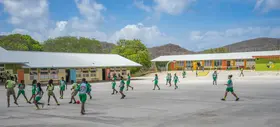
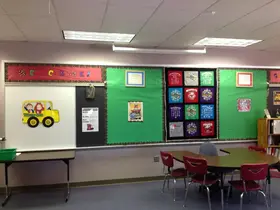
For the 2026 school year, there are 4 public elementary schools serving 1,982 students in Columbia-Brazoria Independent School District. This district's average elementary testing ranking is 5/10, which is in the bottom 50% of public elementary schools in Texas.
Public Elementary Schools in Columbia-Brazoria Independent School District have an average math proficiency score of 45% (versus the Texas public elementary school average of 45%), and reading proficiency score of 47% (versus the 52% statewide average).
Minority enrollment is 45% of the student body (majority Hispanic), which is less than the Texas public elementary school average of 76% (majority Hispanic).
Overview
This School District
This State (TX)
# Schools
6 Schools
6,869 Schools
# Students
2,871 Students
3,744,431 Students
# Teachers
187 Teachers
250,897 Teachers
Student-Teacher Ratio
15:1
15:1
Student By Grade
District Rank
Columbia-Brazoria Independent School District, which is ranked #701 of all 1,193 school districts in Texas (based off of combined math and reading proficiency testing data) for the 2022-2023 school year.
The school district's graduation rate of 95% has increased from 90-94% over five school years.
Overall District Rank
#704 out of 1202 school districts
(Bottom 50%)
(Bottom 50%)
Math Test Scores (% Proficient)
41%
44%
Reading/Language Arts Test Scores (% Proficient)
46%
51%
Science Test Scores (% Proficient)
44%
46%
Graduation Rate
(21-22)≥95%
90%
Chronically Absent Students
(2022-23)26.6%
23%
Students by Ethnicity:
Diversity Score
0.58
0.64
% American Indian
n/a
n/a
% Asian
1%
6%
% Hispanic
33%
54%
% Black
6%
13%
% White
56%
24%
% Hawaiian
n/a
n/a
% Two or more races
4%
3%
All Ethnic Groups
District Revenue and Spending
The revenue/student of $12,011 in this school district is less than the state median of $13,371. The school district revenue/student has stayed relatively flat over four school years.
The school district's spending/student of $14,332 is higher than the state median of $14,099. The school district spending/student has grown by 12% over four school years.
Total Revenue
$35 MM
$74,029 MM
Spending
$41 MM
$78,063 MM
Revenue / Student
$12,011
$13,371
Spending / Student
$14,332
$14,099
Best Columbia-Brazoria Independent School District Public Elementary Schools (2026)
School
(Math and Reading Proficiency)
Location
Quick Facts
Rank: #11.
West Columbia Elementary School
(Math: 52% | Reading: 50%)
Rank:
Rank:
7/
Top 50%10
711 S Gray
West Columbia, TX 77486
(979) 345-5147
West Columbia, TX 77486
(979) 345-5147
Gr: K-5 | 674 students Student-teacher ratio: 16:1 Minority enrollment: 42%
Rank: #22.
Barrow Elementary School
(Math: 40% | Reading: 52%)
Rank:
Rank:
6/
Top 50%10
112 Gaines
West Columbia, TX 77486
(979) 799-1700
West Columbia, TX 77486
(979) 799-1700
Gr: 2-5 | 360 students Student-teacher ratio: 13:1 Minority enrollment: 46%
Rank: #33.
West Brazos J High School
(Math: 44% | Reading: 43%)
Rank:
Rank:
5/
Bottom 50%10
111 Roustabout Dr
West Columbia, TX 77486
(979) 799-1700
West Columbia, TX 77486
(979) 799-1700
Gr: 6-8 | 651 students Student-teacher ratio: 15:1 Minority enrollment: 43%
Rank: #44.
Wild Peach Elementary School
(Math: 35-39% | Reading: 25-29% )
Rank:
Rank:
2/
Bottom 50%10
3311 County Rd 353
West Columbia, TX 77486
(979) 799-1700
West Columbia, TX 77486
(979) 799-1700
Gr: PK-1 | 297 students Student-teacher ratio: 16:1 Minority enrollment: 52%
Recent Articles
Gifted, Honors, and Advanced Tracks: Are They Accessible or Just Advertised?
Learn how to evaluate gifted, honors, and advanced academic programs in public schools, including admission criteria, equity, and the questions every parent should ask.
Algebra Readiness: What Parents Should Ask Before Middle School
Discover how to determine if your child is ready for algebra before middle school, including the questions parents should ask and the skills students need to succeed.
How to Evaluate Reading Instruction in Your Zoned Elementary School
Learn how to evaluate reading instruction in your neighborhood elementary school by recognizing effective literacy practices, asking the right questions, and understanding what quality reading instruction looks like.