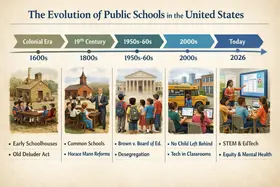
No Child Left Behind: Past, Present, and Future.
The No Child Left Behind Act (NCLB) reshaped American public education when it was signed into law in 2002 under President George W. Bush. It instituted annual standardized testing, accountability measures, and sanctions for schools that failed to meet progress benchmarks. Its stated goal was clear: every child would be held to the same academic standards regardless of background. This policy left a lasting imprint on U.S. schooling, both in what it achieved and what it revealed about federal education reform.
The Origins and Mechanisms of NCLB
NCLB was rooted in the Elementary and Secondary Education Act (ESEA) of 1965. Its core principles were accountability through testing, the goal of closing achievement gaps, and transparency in school performance. For years, states were required to report yearly test results in reading and math for all student groups, from economically disadvantaged learners to English language learners and students with disabilities. Failure to meet “adequate yearly progress” triggered escalating interventions and, in some cases, corrective action.
Parents entering the 2025–26 school year might not know many schools operate today under frameworks that still reflect these origins. Although NCLB itself was replaced, its legacy persists in how policymakers and educators think about data, standards, and accountability.
The Shift to ESSA: Present Policy Landscape
In 2015, Congress replaced NCLB with the Every Student Succeeds Act (ESSA). ESSA preserved annual testing in reading, math, and science but shifted much of the accountability and improvement planning to the states. States now set their own goals and support strategies, with federal oversight ensuring transparency and equity.
What this means for parents now:
State Report Cards matter more. Every state must publish an easy‑to‑navigate report on school performance, including test scores, graduation rates, attendance, teacher qualifications, and per‑pupil spending. This can help families compare schools side by side.
Annual testing is still in place. While ESSA allows states flexibility in assessment design, parents will still see yearly standardized tests. Some states are exploring computer‑adaptive and year‑long testing models that aim to reduce high‑stakes pressure and provide more usable feedback.
Federal enforcement is less prescriptive. Unlike under NCLB, federal policy no longer mandates specific interventions for every school that misses benchmarks. Instead, states determine supports for struggling schools within their accountability systems.
A 2025 retrospective from education advocates noted that while ESSA’s changes are significant, they often feel more technical than transformative to teachers and parents because the culture of test‑driven accountability remains visible in classrooms.
Current Debates: Federal Role and Future Direction
As the 2025–26 school year unfolds, education policy debates have shifted. Some policy groups argue for deeper federal engagement in setting national academic standards and improving assessment quality, while others propose reducing federal influence and returning greater control to states and districts. Discussions tied to national policy plans such as Project 2025 advocate for a dramatic scaling back of federal education authority and a reallocation of roles across agencies.
At the same time, new federal funding streams under laws like ESSER (Elementary and Secondary School Emergency Relief) continue to support recovery and innovation efforts in K‑12 education following pandemic‑era disruptions.
What parents should watch for:
Potential federal reauthorizations of ESEA/ESSA that could revise testing, accountability, or school improvement rules.
State education board decisions changing assessment schedules, graduation requirements, or resource allocations.
Local district planning around staffing, tutoring programs, and special education access—all areas shaped by current accountability systems.
Student Performance, Equity, and Access Trends
Two decades after NCLB’s enactment, inequality in educational access remains a concern. States vary widely in how they support low‑income students and English language learners, and implementation of evidence‑based practices is uneven. Independent analysis shows that while some districts have adopted robust interventions like data‑driven tutoring and multi‑tiered support systems, others struggle to provide consistent support staff or professional development.
Parents preparing for admissions cycles or school choice decisions should pay attention to how districts:
Support struggling learners through tutoring, summer programs, or small‑group instruction.
Report and address achievement gaps in state report cards.
Provide access to advanced coursework and career pathways, especially in underserved communities.
Costs associated with supplemental academic support vary by district. Many include these services at no charge, but some may charge for extended day programs or optional summer enrichment offerings. Planning ahead in early winter or spring can help families secure slots and avoid last‑minute waiting lists.
Admissions Timing and Planning for Families
Parents often ask about the best times to prepare for school admissions and planning:
Elementary and Middle School: Many districts open enrollment and choice applications in late winter (January through March). Check local deadlines and testing requirements early to ensure priority placement.
High School: For specialty programs (magnet schools, career academies), admissions windows may start as early as September for the following school year. Career and technical education pathways often require early planning.
Special Education Services: Evaluation and Individualized Education Program (IEP) meetings can occur year‑round, but annual reviews typically happen near the anniversary of the original plan.
Publicschoolreview.com’s admissions guide explains how to interpret district deadlines and plan for transitions between grade levels.
Parent Resources and Tools
Staying informed is critical. Useful resources include:
State Department of Education websites for searchable state report cards and accountability plans.
Local district calendars for enrollment windows, open houses, and assessment testing dates.
Authoritative news outlets like Education Week for current policy analysis. (For example, a 2025 article explains why ESSA’s tests remain central despite policy shifts.)
Families can also engage with school boards and parent‑teacher associations to influence how local accountability plans are implemented and to share concerns about testing, resource equity, and curriculum choices.
Looking Ahead: Future of School Accountability
Predicting the future of U.S. education policy involves balancing federal goals with state prerogatives. Potential directions include:
Enhanced assessment models that reduce standardized test stress and provide more frequent feedback.
Greater integration of growth‑oriented measures to supplement proficiency benchmarks.
Expanded literacy initiatives, such as state adoption of science‑based reading instruction, which has gained traction in recent legislative efforts.
Continued debates over the extent of federal cohesion versus local control.
For parents and educators, the most immediate influence on their children’s schooling will continue to be state and district decisions around how ESSA is implemented and how schools support students beyond test scores.
Conclusion
NCLB’s legacy persists, but the policy landscape in 2025 is defined by ESSA’s state‑led accountability, evolving assessment strategies, and ongoing debates about equity and federal policy roles. Parents planning for the current academic cycle should focus on understanding local report cards, admissions timelines, and the ways their districts support student learning and equity.