The presence of religion, and more specifically, prayer, in public schools has long been a hot-button topic in the United States. Religious parents maintain that their child has the right to pray and engage in other religious activities while at public school. Meanwhile, parents on the other side of the issue argue that their children should not be subjected to state-sponsored religious activities. Numerous court battles have more clearly defined the role religion can play in public schools; however, the debate regarding the nature and extent of religious practices at school continues.
Religion in Schools: A Brief Overview
In the late 1950s, the Board of Regents of New York’s public schools system composed a nondenominational prayer for students to recite at the beginning of the school day. The prayer was strictly voluntary. A group of parents, including Steven Engel, took exception to the practice and filed suit against the Board. After state courts sided with the Board, thus upholding the school’s right to hold the voluntary morning prayer, Engel appealed the case to the Supreme Court. In 1962 the Court handed down their decision in the landmark case, Engel v. Vitale, in which they declared the practice of school-sponsored prayer unconstitutional.
This video deals with the question of whether or not prayer in school is legal.
In the majority opinion, the justices argued that neither the voluntary nature nor the nondenominational nature of the prayer prevented it from violating the Constitution. The fact that the state of New York composed the prayer and provided time for public school students to recite it violated the Establishment Clause of the First Amendment. The Establishment Clause prevents the government from creating any laws with regard to establishing or endorsing an official religion.
Several other cases have since been heard by the Supreme Court regarding this issue. In Wallace v. Jaffree (1985), the Court ruled that an Alabama law providing schoolchildren with a moment of silence for “meditation or silent prayer” violated the Establishment Clause. In the 1992 case Lee v. Weisman, the Supreme Court ruled that invocations and convocations at graduation ceremonies also violated the Establishment Clause because of the perception that the schools endorse a particular religion. Similarly, in Santa Fe v. Doe (2000), the Court struck down a Texas school district policy that allowed students to give religiously-based speeches over the public address system before football games.
The Perez Case
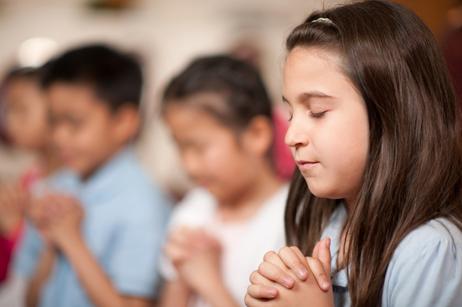
The parents of Gabriella Perez, a five-year-old student at a Seminole County, Florida public school, claim that a teacher on lunch duty prevented their daughter from saying grace before eating lunch. According to Gabriella, a teacher approached her as she began to pray and told her that she was not allowed to do so. Although the principal of the school has interviewed the staff, no one has come forward as the teacher in question. Since then, the Perez family has maintained that their daughter is telling the truth, while school district officials have said that a child that age may have “misinterpreted something.” Regardless, the principal of the school has made it clear that the school has no policies preventing students from engaging in prayer.
This video reports on a student taking the issue of prayer in school to court.
The difference between the Perez incident and the cases heard by the Supreme Court is that Gabriella was acting on her own to pray. While the Supreme Court has ruled repeatedly that states, and therefore state-supported public schools, cannot influence students to engage in religious activities, the Court has made no such ruling that prohibits students from undertaking religious activities of their own accord. Furthermore, the U.S. Department of Education released guidelines in 2000 and again in 2003 that outline exactly what students are allowed to do with regard to religion on public school campuses. According to a report by National Public Radio, under these guidelines, students are allowed to pray or read religious texts such as the Bible or Koran on school grounds so long as they do so on their own time – at lunch or during free time, for example. Additionally, students can form prayer groups and engage in religious activities on school grounds, so long as students coordinate the activities and follow the proper protocol for use of school facilities. Students are also afforded the right to express their religious beliefs with regard to class assignments and homework.
According to these guidelines, it seems that Gabriella Perez was well within her rights to engage in prayer on her own time. She wasn’t attempting to get other children involved in prayer, nor was she causing any kind of disruption that would diminish the safety and decorum of the lunchroom. If a teacher did indeed inform Gabriella that she could not pray at school, that teacher is misinformed.
Since the incident, the Perez family has taken their daughter out of school so that they can homeschool her. They are not filing a lawsuit at this time; however, their legal team is demanding an official apology from the school district, as well as an in-depth investigation as to who might have told their daughter she could not pray.