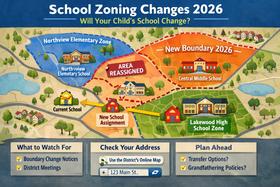
Buying a home near a desirable public school can feel like a smart investment in a child's education. Parents may spend months researching school ratings, visiting neighborhoods, and prioritizing properties within walking distance of their preferred campus. However, proximity does not guarantee enrollment, and overlooking this distinction can lead to unexpected complications after purchasing a home.
A house located just two blocks from an elementary school may actually belong to another school's attendance zone. Even when a real estate listing identifies a particular school, the information may be outdated, incomplete, or based on geographic distance rather than official enrollment eligibility. Families who rely exclusively on these listings risk discovering that their children are assigned to a different school than anticipated.
In 2026, verifying school assignment before buying a house should be an essential part of the homebuying process. Families need more than a school name displayed on a property listing. They need confirmation that the exact address qualifies for the intended school during the academic year their child will enroll. Understanding how to investigate assignments, resolve conflicting information, and obtain reliable confirmation can help parents avoid making a major financial decision based on incorrect assumptions.
Why the Nearest School May Not Be Your Assigned School
Public school attendance boundaries are not always drawn around the nearest campus. Districts may divide neighborhoods according to enrollment capacity, transportation routes, residential development, or historical boundary decisions. Consequently, families living on opposite sides of the same street may attend different schools, even when both homes are located within walking distance of the same campus.
The New York City Department of Education explains that a child's zoned elementary school may not be the school closest to their address. Its enrollment guidance also distinguishes between zoned schools, which prioritize students living within designated areas, and non-zoned schools, which use other admission priorities. These distinctions illustrate why parents should not assume that a short walking distance, shared ZIP code, or neighborhood name establishes enrollment eligibility.
This issue becomes particularly important when purchasing property near an attendance boundary. A family may choose a home specifically because of its proximity to a highly regarded school, only to discover that the property falls outside the school's designated enrollment area. Verifying the assignment directly with the district before committing to the purchase can prevent this misunderstanding.
The Three Sources Homebuyers Should Compare
Before making an offer, families should compare information from three sources: the real estate listing, the school district's official address locator, and the district enrollment office. Each provides different information, and understanding their limitations is essential.
Real estate listings often identify nearby schools and may include ratings, distances, or neighborhood descriptions. However, these details do not necessarily confirm enrollment eligibility. District address locators generally provide more specific information about which schools serve a particular property, although online records may not immediately reflect recently approved changes. The district enrollment office can clarify current policies, confirm assignments, and explain whether additional enrollment requirements apply.
For example, a real estate website might identify Lincoln Elementary as the property's school, while the district's address locator assigns the home to Washington Elementary. In this hypothetical situation, parents should contact the district enrollment office, provide the complete property address, and request clarification in writing.
A seller's statement that their children attended Lincoln Elementary does not resolve the discrepancy. Their enrollment may have resulted from a previous attendance boundary, an approved transfer, or a special placement arrangement. Comparing these sources before purchasing helps families distinguish reliable assignment information from assumptions based on past enrollment or geographic proximity.
How to Verify School Assignment Before Signing a Contract
The most important step in verifying school assignment is obtaining confirmation for the property's exact address. Parents should begin with the district's official school locator rather than relying exclusively on a general internet search. Entering the complete street address, including an apartment or unit number where applicable, can help identify the schools currently associated with the property.
The New York City Public Schools enrollment guidance provides an example of this process, directing families to use an address-based school search and contact the appropriate school or enrollment office. After reviewing the online information, parents should contact their district directly to confirm the results.
The inquiry should include the property's address, the child's expected grade, and the academic year of intended enrollment. Parents should also ask whether the identified school represents a guaranteed assignment, a priority placement, or an option requiring a separate application. These distinctions can determine whether purchasing a particular property will actually provide access to the desired school.
Families should save the district's written response, including the date, the department providing the information, and any relevant qualifications. Written confirmation creates a useful record of the information provided at the time of purchase, although it does not necessarily prevent future boundary changes or guarantee placement under every circumstance.
What to Do When School Locator and District Records Disagree
Conflicting school assignment information requires additional investigation, particularly when a property sits near an attendance boundary. An online map may not yet reflect a recently approved change, or an address may be incorrectly associated with the wrong street segment. In some cases, different websites may display information for different academic years, creating confusion for families planning a future move.
The Fairfax County Public Schools boundary review guidance illustrates why the applicable school year matters. During its 2026 boundary transition, the district explained that its locator initially reflected 2025–26 assignments while future-year information awaited a system update.
Parents encountering contradictory records should request a manual address review from the enrollment or student assignment department. Providing the property's legal address or parcel information may help distinguish it from similarly named streets or neighboring properties. Families should also ask whether a recently approved boundary change explains the discrepancy and when updated records will become available.
Rather than relying on verbal reassurance from a real estate agent or seller, parents should seek direct clarification from the district. Whenever possible, the discrepancy should be resolved before the purchase becomes financially binding, particularly when access to a specific school is a deciding factor.
Check the School Assignment for Every Grade Level
One of the most common mistakes families make when buying a home is verifying only the elementary school. Parents with a second grader may be satisfied with the neighborhood elementary school but overlook the middle and high schools associated with the same address. Because attendance boundaries can differ by grade level, a property assigned to one elementary school may feed into a middle school farther away than expected.
Parents should request the complete elementary, middle, and high school pathway, including any transition rules affecting students already enrolled. This information is especially important for families planning to remain in the same home throughout their children's education. A property that meets current elementary school needs may present different educational or transportation considerations several years later.
Public School Review's guide to researching school districts when buying a home provides additional context on evaluating a district before committing to a property. Looking beyond the immediate school assignment allows families to consider whether the home will continue meeting their educational needs as their children advance through different grade levels.
Understand What Written Confirmation Actually Guarantees
Obtaining written confirmation of a school assignment is valuable, but parents should understand precisely what that confirmation means. Some districts guarantee attendance at a designated neighborhood school for eligible residents, while others operate systems involving enrollment priorities, school capacity, or application procedures. A family may qualify for consideration at a particular school without receiving an unconditional placement guarantee.
The New York City Department of Education's high school admissions guidance demonstrates how zoned programs can provide guarantees or priorities depending on the program's admission rules. These differences highlight the importance of asking whether enrollment occurs automatically once residency is established or whether additional steps are necessary.
Parents should also determine whether the confirmation remains valid if they purchase the property but do not occupy it until a later date. Owning a home and establishing qualifying residency are not always equivalent under district enrollment policies. Understanding documentation requirements, enrollment deadlines, and residency conditions before purchasing can help families avoid unexpected complications.
Protect Your Home Purchase When School Assignment Is Essential
When access to a particular public school is a major reason for purchasing a home, families should consider how that requirement fits into their purchase agreement. Discovering that the assigned school differs from the one advertised can create significant difficulties, particularly after buyers have paid for inspections, arranged financing, or made deposits.
Parents should discuss school assignment verification with their real estate agent and a qualified local attorney before signing a purchase agreement. Depending on applicable laws and contract terms, it may be possible to negotiate a contingency requiring satisfactory confirmation of school assignment. Such provisions are not universally available, and buyers should not assume that an incorrect school listing automatically provides grounds to cancel a purchase.
The safest approach is to complete the verification before contractual deadlines make withdrawal expensive or difficult. Families should also retain copies of relevant district correspondence and any school-related representations included in the property listing. Although these records cannot eliminate every potential problem, they can provide important documentation if questions arise during the transaction.
What If the School Assignment Changes Before Closing?
School assignments can change between the initial home search and the family's move-in date. A district might approve new attendance boundaries, open another school, or revise enrollment procedures while a property transaction is underway. Consequently, information that was accurate when a family first viewed a house may no longer apply when the purchase is finalized.
Parents should monitor pending school board decisions and confirm the assignment again shortly before closing. Reviewing district announcements, enrollment projections, and proposed boundary adjustments can help identify developments that may affect the property.
Public School Review's guide to evaluating school closure risks before moving explains how enrollment trends, school capacity, and district planning decisions can influence families purchasing homes. Understanding these broader considerations helps parents evaluate whether a property's educational advantages are likely to remain practical over time.
If an assignment changes before closing, buyers should review the consequences with their legal adviser before proceeding. This is particularly important when the original school placement was a determining factor in choosing the property.
A Final Verification Checklist Before Buying
Before committing to a home purchase, parents should have clear answers to several essential questions. They should know which elementary, middle, and high schools serve the property's exact address, whether those assignments apply to the intended enrollment year, and whether placement is guaranteed or dependent on available seats. They should also determine whether pending boundary changes could affect the property and retain written confirmation of the district's response.
If any of these details remain uncertain, further investigation is warranted. Families should consider whether the property would remain suitable if school assignments changed in the future, particularly when transportation requirements, childcare arrangements, and alternative enrollment opportunities could affect their daily routines.
Public School Review's cost-benefit analysis of moving for a better public school provides additional perspective on evaluating the financial and educational implications of relocation. While school quality may influence a family's housing decision, parents should consider the broader financial commitment and the possibility that school assignments may evolve over time.
Make School Assignment Verification a Homebuying Priority
Before buying a house, verifying school assignment is one of the most practical steps parents can take to protect their family's educational plans. A nearby campus, an attractive school rating, or a real estate advertisement cannot establish enrollment eligibility. Only the responsible school district can explain how its current policies apply to a particular address.
By comparing official records, obtaining written confirmation, checking every grade level, and investigating discrepancies before signing, families can significantly reduce the risk of unexpected school assignments. These precautions are especially important when access to a preferred public school is a primary motivation for purchasing a property.
The right home should meet both housing and educational needs. Confirming the actual school assignment before making a financial commitment helps ensure that families understand exactly what they are purchasing and can move forward with greater confidence in their children's educational future.