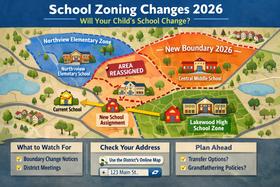
School attendance boundaries are not permanent. As communities grow, neighborhoods evolve, and student populations shift, school districts periodically redraw attendance zones to balance enrollment and make the best use of available resources. While these changes are often necessary, they can create uncertainty for families who carefully selected a neighborhood based on school assignments.
For parents, rezoning can mean much more than attending a different school. It may affect transportation, academic continuity, extracurricular involvement, friendships, and long-term educational planning. Understanding why boundary changes occur and knowing how to participate in the process can help families prepare for potential changes before they take effect.
As Public School Review explains in Public School Boundaries & Equity in 2026, districts must balance enrollment while ensuring students have equitable access to educational opportunities. Achieving that balance often requires periodic adjustments to attendance zones as communities continue to grow.
Why School Boundaries Change
Most school boundary adjustments are driven by changes in student enrollment. Rapid residential development may cause one school to exceed its capacity while another nearby campus has available space. District leaders must periodically redistribute students to maintain reasonable class sizes and ensure facilities are used efficiently.
Population trends also influence rezoning decisions. Information published by the U.S. Census Bureau helps school districts anticipate future growth by identifying demographic changes and housing patterns that may affect student enrollment over the coming years.
In other situations, districts adjust boundaries after constructing a new school, closing an existing campus, or expanding specialized academic programs. These changes are intended to improve operational efficiency while providing students with access to appropriate educational resources.
Although these decisions can be difficult for affected families, districts generally seek solutions that serve the broader community while minimizing disruption whenever possible.
How Rezoning Can Affect Families
When attendance boundaries change, the effects often extend well beyond a student's classroom assignment.
Students may need to adapt to a new school environment, build relationships with different teachers, and establish new friendships. Families may face longer commutes, revised transportation schedules, or changes to before- and after-school care arrangements. Older students involved in athletics, performing arts, or extracurricular organizations may also worry about completing programs they have participated in for several years.
Parents who purchased homes specifically to access certain schools may understandably find rezoning especially frustrating. While school assignment is an important consideration when choosing where to live, attendance boundaries remain subject to change as districts respond to shifting enrollment patterns.
Rezoning Does Not Always Mean Immediate Transfer
One of the most common misconceptions is that every boundary adjustment requires students to move schools immediately.
Many districts adopt transition policies that reduce disruption for families. Depending on local policy, students already enrolled at a school may be allowed to remain through the highest grade level, particularly if they are approaching graduation. Younger siblings, however, may still be assigned to a different campus under the revised attendance boundaries.
Districts may also implement boundary changes over multiple years rather than immediately moving every affected student. These phased approaches provide families additional time to prepare and help schools manage enrollment more effectively.
Because policies differ widely from one district to another, parents should carefully review official district communications whenever rezoning proposals are announced.
Understanding the Rezoning Process
Although every district follows its own procedures, most boundary reviews include several opportunities for public participation.
A typical process often includes:
- Enrollment studies and demographic projections.
- Development of one or more proposed boundary maps.
- Public meetings or community forums.
- Opportunities for written public comment.
- Review by the school board before a final vote.
Many districts publish draft attendance maps several months before implementation, giving families time to review proposals and understand how their neighborhoods may be affected.
Public School Review explores this planning process further in School Zoning Changes 2026: How to Know if It Affects Your Child's Assignment, which outlines how districts communicate proposed changes and what parents should expect during the review period.
Why Parent Participation Matters
School boards typically encourage public feedback before approving new attendance boundaries. Parents who participate constructively can help decision-makers better understand how proposed changes may affect transportation, sibling assignments, neighborhood cohesion, and student well-being.
Attending public meetings also allows families to hear the reasoning behind proposed adjustments, ask questions, and learn whether alternative boundary scenarios are under consideration.
Constructive participation is generally more effective than waiting until after final decisions have been made. Families who stay informed throughout the process are better positioned to plan for potential changes and advocate for practical solutions.
How Parents Can Prepare
Although families cannot always prevent attendance boundary changes, they can take practical steps to stay informed and reduce uncertainty.
Parents should begin by monitoring school board agendas, district newsletters, and official announcements throughout the year. Many districts provide email alerts whenever boundary studies or enrollment reviews begin.
It is also worthwhile to review attendance maps annually, especially if significant residential development is occurring nearby. Growing neighborhoods often experience enrollment shifts that eventually lead to rezoning discussions.
If a boundary review is announced, consider taking the following actions:
- Attend community information sessions and school board meetings.
- Review proposed attendance maps carefully.
- Ask questions about grandfathering policies and transportation.
- Submit written comments before public deadlines.
- Discuss possible changes with your child before decisions become final.
Taking these steps allows families to understand the process while ensuring their concerns become part of the public record.
Questions to Ask Your School District
Parents often receive limited information when rezoning discussions first begin. Asking thoughtful questions can provide greater clarity about how proposed changes may affect their family.
Helpful questions include:
- Why are boundary changes being considered?
- What enrollment data supports the proposal?
- Will current students be allowed to remain at their existing school?
- How will transportation routes change?
- Will siblings be permitted to attend the same school?
- What is the timeline for implementation?
- Will additional public meetings be held before a final decision?
Clear communication helps families prepare for possible transitions and better understand the district's long-term planning objectives.
Understanding Grandfathering Policies
Many districts recognize that moving students during the middle of their education can create unnecessary disruption. As a result, some districts adopt grandfathering policies that allow certain students to remain at their current school despite revised attendance boundaries.
These policies vary considerably. Some districts allow only graduating students to remain, while others extend grandfathering to all currently enrolled students. In some cases, transportation may no longer be provided even if students are permitted to stay.
Because these policies differ widely, parents should review official district guidance rather than relying on information shared through neighborhood social media groups or informal conversations.
Planning Ahead When Buying a Home
Many families consider school assignments when purchasing a home. While researching attendance boundaries remains an important part of that decision, parents should remember that school assignments are never guaranteed permanently.
Reviewing historical enrollment trends, planned residential developments, and district growth projections can provide useful insight into whether future rezoning is likely. Information available through the U.S. Census Bureau can also help families understand population growth patterns that may eventually influence school planning.
Families should view school boundaries as one factor among many when evaluating a neighborhood rather than assuming current attendance zones will remain unchanged indefinitely.
Using Data to Better Understand School Assignments
School districts increasingly rely on demographic and enrollment data to guide boundary decisions. Student population projections, facility capacity, transportation efficiency, and neighborhood growth all influence how attendance zones are designed.
Parents interested in understanding these broader trends can explore national enrollment information published by the National Center for Education Statistics. While national data cannot predict local boundary changes, it provides valuable context for understanding how enrollment patterns influence school planning across the country.
Public School Review also examines these long-term considerations in Public School Boundaries & Equity in 2025, highlighting how districts balance enrollment demands while working to provide equitable educational opportunities.
Looking Beyond Attendance Boundaries
Although school assignments matter, they represent only one part of a child's educational experience.
Strong teachers, supportive school leadership, engaged families, and meaningful extracurricular opportunities often have a greater influence on long-term student success than a boundary line alone. Parents should continue evaluating schools based on academic programs, student support services, school climate, and opportunities for enrichment rather than focusing exclusively on attendance zones.
Boundary adjustments can certainly create challenges, but they also provide districts with opportunities to balance resources and improve learning environments for all students.
Conclusion
School boundary changes and rezoning are a reality for many public school districts as communities grow and student populations evolve. While these decisions can be disruptive, understanding why they occur and participating in the public planning process allows families to respond with greater confidence.
By staying informed, reviewing proposed attendance maps, asking thoughtful questions, and engaging with school leaders throughout the decision-making process, parents can better protect their child's educational plan while adapting to changing circumstances.
Although no family can guarantee that attendance boundaries will never change, preparation and active participation remain the best tools for navigating the rezoning process successfully.