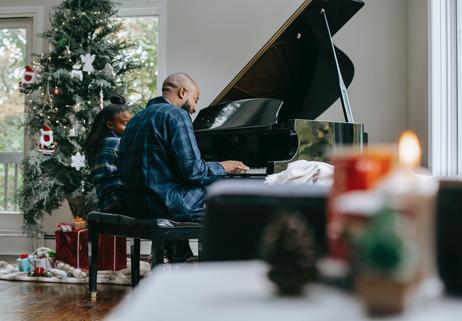
Songs such as “Silent Night” and “Joy to the World” have long been considered staples of the annual holiday concerts performed by school bands, orchestras, and choirs. However, friends and family of students in New Jersey’s South Orange Maplewood School District no longer hear these songs at their annual holiday concerts. Across the nation, school districts are changing their policies, banning music with religious themes at school-sponsored events.
One parent in the South Orange Maplewood district has been engaged in a legal battle with the district since 2004 aimed at restoring Christmas carols to holiday concerts, but he has been unsuccessful thus far. Michael Stratechuck, the parent in question, filed his initial lawsuit against the school district in December 2004. In his initial complaint, Stratechuk argued that the district's policy banning music with religious themes (including instrumental versions of religious songs) from being played at the school's December concerts was a violation of the First Amendment's protection of freedom of worship.
Stratechuk appealed the district's court's ruling in favor of the school district, and the United States Appeals Court for the Third Circuit reheard the case in September 2009. Unfortunately for Stratechuk and his supporters, the appeals court recently issued a decision opinion affirming the lower court's ruling and declaring that the school district's policy does not violate the establishment clause of the First Amendment.
The Case in Favor of the Christmas Carols
Government Must Not be Hostile Towards Religion
The New York Times reported that in his original complaint, Stratechuk claimed that the school district's prohibition of Christmas carols from holiday concerts was “a government-sponsored message of disapproval and hostility toward religion.” Government hostility towards religion was a key element of Stratechuk's argument against the district's policy, and one which Stratechuk's lawyer, Robert Muise, underscored in comments he made to the New York Times after the appeals court reheard the case in September 2009.
Muise, who works for the Thomas More Law Center and focuses on defending Christian freedom of expression, told the Times that "the establishment clause requires the government to be neutral towards religion." The Establishment Clause is the popular term for the first part of the First Amendment of the U.S. Constitution, which states that "Congress shall make no law respecting an establishment of religion.”
According to Muise, the Establishment Clause must be interpreted as not only prohibiting governments from "endorsing or approving a religion" but also from "disapproving or acting hostile towards religion." Thus, by charging the school district with promoting a "message of disapproval and hostility towards religion," Stratechuk was charging the district with violating the First Amendment of the Constitution.
Negative Popular Reaction to the Policy
Muise cited what he called a "robust, quick reaction" among members of the school district's surrounding community to the decision to ban even instrumental Christmas carols as evidence that the policy was "hostile to religion" and created "political divisiveness along religious lines." He argued that this showed the policy would offend the sensibilities of a reasonable person, which is a common standard that courts apply when deciding difficult questions such as this.
The Court's Opinion
Keeping Concerts Secular is Not Hostile to Religion
The three judges of the appeals court wrote in their decision that "neutrality towards religion is quite distinct from hostility towards it," taking the position that it is not desirable to categorize every government action as being either pro- or anti-religion. The judges cited several cases in which courts have "rejected the suggestion that 'secular' means 'anti-religious." Following this line of reasoning, the judges rejected Muise's argument that the school district's policy of maintaining a secular playlist at holiday concerts was hostile to religion.
Popular Reaction Not Relevant
The appeals court judges also rejected the argument that a generally negative public reaction to the school district's policy should be taken as an indication of the policy's unsoundness, stating that the "constitutionality of a school board’s policy towards religion cannot be decided by reference to popular opinion.”
School District May Uphold Such a Policy Even if Not Necessary Under First Amendment
Finally, the judges wrote that although it is not clear that the school district needs to have such a policy in order to comply with the Establishment Clause, it is also not a violation of the Establishment Clause to have such a policy.
What's Next?
New Jersey Assemblywoman Mila Jassey, a former school board member and current representative of the school district in the state Legislature, told the New Jersey Star-Ledger that she was "happy" that the case had been resolved and hoped that "we can finally put it behind us." However, that may not happen yet; Muise told the New York Times that he and his client will ask the appeals court to rehear the case, and they may also consider appealing the case to the U.S. Supreme Court.
This video offers another report on Christmas music being banned in schools.
Silenced Carols Across the Country
New Jersey is not the only state quieting religious Christmas carols at public school events. In Philadelphia, a federal appeals court also upheld the ban, giving school authorities the right to exercise their “sound” judgment in creating an inclusive campus environment, as reported by the Philadelphia Inquirer.
As public schools grow increasingly sensitive to modern times and different religious, political, and social beliefs their students hold, Christmas carols may certainly be a sound of the past on campuses across the country.
Questions? Contact us on Facebook. @publicschoolreview