Evaluating Public Schools

This section provides tools to aid in finding the best public school option for your child. Compare private and public schools, explore school zoning issues, and delve into the public school grading and ranking system. Find information on the safest schools and what they are doing right.

View the most popular articles in Evaluating Public Schools:

How Schools Recovered from Hurricane Sandy

Updated
|
How Schools Recovered from Hurricane Sandy
There were many challenges facing schools in New York and New Jersey, as they struggled to get ready for students and balance the ongoing need to provide shelter to those displaced by the storm.

The hurricane that ripped through the Northeast October 22 through November 2, 2012, left a trail of destruction that impacted every aspect of the lives of the residents there, including the children. Many students and teachers were left without a school to return to since the storm-ravaged school buildings to the point where they were not considered inhabitable. In addition to the challenges of the storm clean-up, schools that were currently being used as shelters had to find a way to allow students and strangers to live together harmoniously, at least for a short period of time. How did schools recover from unprecedented Hurricane Sandy? Very slowly, in some areas.

This video describes how Storm Sandy evolved.

Challenges Schools Faced

To understand the many challenges facing schools that were in the path of Hurricane Sandy, the Wall Street Journal went inside the thought process of one of New Jersey’s superintendents. Dr. James A. Crisfield, the superintendent of Milburn Township Public Schools, explained to the publication that many factors had to be considered before children could be allowed back into schools, including:

  • Electricity - Many schools were still without power and they could not reopen until electricity was back on.
  • Gasoline – Gasoline shortages across the region made it difficult to get sufficient emergency personnel and school buses running. In addition, faculty and administration were unable to make it to school due to fuel shortages.
  • Damage
. . .read more

Political Attire in Public School: Protected by the Constitution?

Updated
|
Political Attire in Public School: Protected by the Constitution?
Can public school students wear political clothing? Learn what the First Amendment says, how schools balance free speech and order, and what parents should know about student expression in 2026.

Presidential election season is once again in full swing, and yard signs, bumper stickers, campaign buttons, and social media posts all demonstrate Americans' support for their preferred candidates. Political expression remains an important part of civic participation, but as one high school student in Philadelphia discovered, expressing those views at school does not always go as planned. This student got more than she bargained for when she wore a pink Romney-Ryan T-shirt to school. She was publicly humiliated and harassed for her choice, not by fellow students, but by her own teacher.

The Samantha Pawlucy Story

Samantha Pawlucy was a sophomore at Charles Carroll High School in the Philadelphia area. Pawlucy decided to wear her Romney-Ryan T-shirt to class on a "dress-down" day when the shirt fit within the parameters of the school dress code. It was a daring thing to do in a community with one Republican for every six Democrats. However, Pawlucy had no idea just how traumatic the response to her attire would be.

Pawlucy's geometry teacher, Lynette Gaymon, called attention to Pawlucy's shirt during class. According to reports at the time, Gaymon told Pawlucy to remove the shirt. When Pawlucy refused, Gaymon compared wearing the shirt to coming to school wearing a Ku Klux Klan T-shirt. She explained that Charles Carroll High School was a "Democratic" school and then told Pawlucy to leave her classroom.

In this video, an attorney comes down hard on the teacher who was accused of bullying Samantha.

. . .read more

Is Your Child's School a Blue Ribbon School?

Updated
|
Is Your Child's School a Blue Ribbon School?
Did your child's school make the list? We cover the latest Blue Ribbon Schools awards given by Education Secretary Arne Duncan.

The U.S. Department of Education recently released its 2012 National Blue Ribbon Schools awards, which include 219 public and 50 private schools across the country. The National Blue Ribbon Schools program has been a mainstay of the education system in the U.S. for the past three decades, providing parents, students, and members of the community with information about the top-rated schools in the country. The awards are primarily intended to serve as an example and inspiration for the entire education system in the U.S.

Announcement of Awards Eagerly Anticipated

Secretary of Education Arne Duncan recently announced the recipients of the awards from Arlington Traditional Elementary School, one of the 2012 Blue Ribbon Schools, according to a report in the Washington Post. The program recognizes public and private primary and secondary schools that have demonstrated outstanding student achievement or improvement over the past academic year.

“Our nation has no greater responsibility than helping all children realize their full potential,” Secretary Duncan was reported by the Examiner as stating at the award presentation. “Schools honored with the National Blue Ribbon Schools award are committed to accelerating student achievement and preparing students for success in college and careers. Their work reflects the conviction that every child has promise and that education is the surest pathway to a strong, secure future.”

In this video, Superintendent Dr. Pat Murphy talks with Principal Holly Hawthorne of Arlington Traditional School about the school's 2012 Blue Ribbon School selection by the U.S. Department

. . .read more

Police Make Hundreds of Arrests at NYC Schools Last Year

Updated
|
Police Make Hundreds of Arrests at NYC Schools Last Year
We examine recently released statistics that show more than 880 NYC students were arrested at public schools last year. Were minority students targeted?

A new report issued by the New York Civil Liberties Union indicates that the NYPD is making an average of around four arrests each day in New York City public schools. In addition, the police wrote around seven summons daily for students with less serious infractions. The report has been met with widespread concern, particularly in light of the fact that the large majority of students arrested were students of color. Is the NYPD exercising too much power in the public schools of the city, or are the police merely doing the job they were hired to do? The answer to that question appears to depend on who is asked.

Hundreds of Arrests on Record

The NYCLU recently released its report after conducting an analysis of police activity in the city’s public schools. The agency took advantage of a new city law to compile their report, which requires documentation and disclosure of school safety information, according to a report at SI Live. The report found that during the 2011-2012 school year, the police made a total of 882 arrests of students while the students were at school, with an additional 1,666 summonses issued.

Around 95 percent of the students arrested were black or Hispanic, despite the fact that students of color only make up around 71 percent of the total student population in the city. Of the minority students arrested, 63 percent were black students. Around 48 percent of the summonses issued were to students

. . .read more

What are the Best High Schools in America? Top 15 Ranked Schools

Updated
|
What are the Best High Schools in America? Top 15 Ranked Schools
U.S. News recently released its latest list of the best high schools in America. We’ll take a look at some of the schools on the list and whether the rankings are warranted.

A report from U.S. News & World Report reveals the top-rated high schools in America, but it is not without its share of accolades and controversy. Today, the rankings continue to attract national attention, with U.S. News annually evaluating thousands of public high schools using updated measures of college readiness, state assessment performance, graduation rates, and underserved student achievement. While some schools celebrate their inclusion on the list, others are left scratching their heads, wondering how and why they were selected among so many excellent high schools across the country.

Parents should remember that rankings are just one tool for evaluating schools alongside school culture, academic offerings, extracurricular activities, and student support services. For additional guidance, read 10 Tips for Choosing the Best High School for Your Child.

Three Steps to the Top-Ranked Schools

The creation of the U.S. News list was originally achieved through a three-step process implemented by the American Institutes for Research (AIR). While the methodology has evolved over the years, it continues to focus on objective measures of school performance and college readiness.

First, the publication looked at student performance by weighing math and reading scores on state high school proficiency tests against the percentage of economically disadvantaged students at the school. Schools that scored statistically higher than the state average were evaluated through the next step in the process.

Next, U.S. News and AIR looked at whether the least advantaged students were performing at a higher rate than

. . .read more

Recent Articles

The School Choice Comparison Worksheet: 15 Factors Beyond Test Scores
Compare public schools with confidence using this 15-factor worksheet that looks beyond test scores to school culture, programs, safety, and student support.
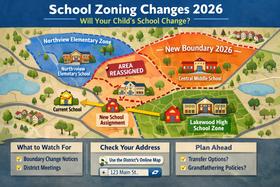
Boundary Changes and Rezoning: How to Protect Your Child's School Plan
Learn why school boundary changes happen, how rezoning affects families, and the practical steps parents can take to protect their child's educational plan.
Teacher Turnover: How to Read the Warning Signs
Learn how to identify warning signs of teacher turnover, what causes frequent staff changes, and how parents can evaluate school stability.

Evaluating Public Schools

SCHOOL ZONING
Learn more about zoning rules, how they impact schools and your child. This section offers information on the history of school zones, what they are, and how they work. Get information on who decides school boundaries and the impact those decisions have on the community.
GETTING STARTED
An overview of school designations, best practices for evaluating your options, and tips on choosing the best school for your child. Learn about Blue Ribbon, Vocational and Special Education schools. Get tips on finding the right school in a new neighborhood, city or state.
GRADING AND RANKING SCHOOLS
Explore the public school grading/ranking system, how it works and what it means. Get latest national rankings and read what critics of school grading have to say. Take a look at the nation’s top performing schools as ranked by U.S. News and Newsweek.
PUBLIC SCHOOL SAFETY
A comprehensive look at the safety of US public schools. Learn what schools are doing to combat gangs and drugs, prepare for natural disasters, and protect your children from predators. From web cameras to armed guards, see what tools public schools are employing to keep kids safe.
PUBLIC VS. PRIVATE SCHOOLS
A comparison of public and private schools, the pros and cons of each, and a look at the cost of getting a stellar education at both. Take a look at some of the most expensive schools, notable public school alumni, and learn more about “private” public schools.