Evaluating Public Schools

This section provides tools to aid in finding the best public school option for your child. Compare private and public schools, explore school zoning issues, and delve into the public school grading and ranking system. Find information on the safest schools and what they are doing right.

View the most popular articles in Evaluating Public Schools:

Paupers and Princes: Economic Inequality at Public Schools

Updated
|
Paupers and Princes: Economic Inequality at Public Schools
The economic divide between our nation's public school students is growing wider and deeper. Learn about a new federal report that reveals the growing ranks of poverty-stricken public schools.

For decades, studies have shown that schools with a high number of students living in poverty do not experience the same academic success as schools in wealthier districts. Many programs have been instituted to narrow the gap since the "War on Poverty" was launched by President Lyndon B. Johnson in 1965 and the Elementary and Secondary School Act of 1965 was established.

Unfortunately, recent reports show that instead of narrowing the poverty gap, there is a growing divide between low and high-income students at public schools.

The Condition of Education 2010

The Condition of Education 2010 has recently been released by the National Center for Education Statistics (NCES). This annual report is federally mandated to provide an assessment of the condition of the educational system in the United States. This year's findings were sobering, as they indicate that the gap between high and low-poverty schools is a widening one.

According to the report, high-poverty schools are defined as institutions where at least 75% of the students enrolled are eligible for the free or reduced-price lunch program. Approximately 6 million elementary students and one million secondary students are enrolled in high-poverty schools today.

This video looks at the disparity between rich and poor school districts.

Characteristics of High-Poverty Schools

The NCES report looks at a variety of characteristics of high-poverty schools, including:

  • Locations of the schools
  • Characteristics of the students
  • Qualifications and characteristics of
. . .read more

Signs of Sex Abuse at School: What Parents Should Know

Updated
|
Signs of Sex Abuse at School: What Parents Should Know
Nearly 10% of students will encounter sexual misconduct at school. Make sure you know how to protect your child and recognize the signs of potential sex abuse.

Much press coverage has been recently dedicated to the accusations of sexual abuse by priests within the Catholic Church. Parents and religious leaders have risen up in protest, particularly since numerous victims are still living in the aftermath of the abuse years after the incidents occurred.

However, a recent article on LifeSiteNews suggests that the violations of the church pale in comparison to the sexual abuse that goes in on some schools today. A study conducted in 2004 by the U.S. Department of Education stated that "The physical sexual abuse of students in schools is likely more than 100 times the abuse by priests."

No parent likes to think that a child might be mistreated while at school. However, incidents of sexual abuse do happen in schools, which many experts liken to incest. An organization known as Stop Educator Sex Abuse, Misconduct and Exploitation (S.E.S.A.M.E.) defines sexual misconduct as, "Behavior by an educator that is directed at a student and intended to sexually arouse or titillate the educator or the child." Unfortunately, behavior like this is a concern for parents, educators, and students alike.

The American Academy of Child & Adolescent Psychiatry reports that "Child sexual abuse is a major public health problem. About 1 in every 4 girls and 1 in every 13 boys in the US experience sexual abuse at some time in their childhood. The vast majority of sexual abuse is committed by someone that the child or their family

. . .read more

Can You Afford a Stellar Public School Education?

Updated
|
Can You Afford a Stellar Public School Education?
Dissect "America's Best Schools for Your Housing Buck" and learn about the top ranked public schools in America in cities where the median home price is as low as $200,000.

In choosing the best place to raise a family, parents have always ranked the quality of a school district. For many, choosing the most expensive school district in the region was often equivalent to giving kids the best possible start in life. However, quality education can be found at all economic levels, as long as you are willing to take the time to research each district individually when choosing a home for your family.

Forbes recently made the search a bit easier by publishing "The Best Schools for Your Housing Buck," which lists the top 25 school districts across the country, based on a variety of criteria. Forbes researched the top school districts in the country that provided both high-quality education and fabulous housing for residents. While some of the districts on this list are still relatively pricey for the average American, there are also some locations that provide positive educational opportunities for a fraction of the price.

Smart Criteria Used

Forbes and GreatSchools looked at more than 17,000 cities and towns in 49 states to assemble their listing. Factors considered included:

  • Test score data
  • Public school enrollment from K-12
  • Median home prices for 2009
  • Population data for 2009

Some cities were eliminated from the list because of populations less than 10,000 since these areas offered insufficient data for analysis. The study also left out the state of Nebraska, since it does not currently offer a standardized state-wide testing process to evaluate student performance. Cities with fewer

. . .read more

Selecting a Public High School Based Upon Their Graduates’ Success

Updated
|
Selecting a Public High School Based Upon Their Graduates’ Success
What is the best way to evaluate the quality of a public high school? Learn about the data available that helps parents choose a high school based upon how well their graduates perform in college.

AP courses, state standardized test scores, and teacher-to-student ratios: these are all measures utilized by parents to judge a public high school’s quality. However, what if parents have been evaluating all the wrong statistics? What if the best way to measure a public high school’s educational quality is by the success its students achieve after they graduate?

While some public high schools will proudly publish the colleges to which their seniors have been accepted, what happens to these students once they enter into the towers of higher education? Has their public high school education properly prepared them for the rigors of college?

All of these answers – and more – can actually be answered through research and data compiled by the National Student Clearinghouse.

Measuring a Public High School’s Success

As reported by the Washington Post, the National Student Clearinghouse manages a database of more than 93 million students enrolled in over 3,300 colleges. While this information was once compiled for student loan purposes, the Clearinghouse has now made this data available for high schools.

Included in the National Student Clearinghouse reports is a bevy of valuable information, such as:

  • Institutions of enrollment
  • College transfer statistics
  • College graduation rates
  • Types of degrees earned
  • Majors pursued

The conclusions that could be gleaned from these reports are invaluable for both high schools and parents. For example, in the sample report evaluated by the Washington Post, the data showed:

  • 76% of
. . .read more

Does Your Child Attend a “Private” Public School?

Updated
|
Does Your Child Attend a “Private” Public School?
Not all public schools are created equal. In fact, some are even considered "private" public schools. Learn about the study that delves into which states have the most "private" public schools and what ramifications these statistics have on education policy and taxation.

A recently issued report by the Thomas B. Fordham Institute, a non-profit educational think tank, indicates that more than 1.7 million American students attend what the report terms “private-public schools” – that is, public schools where low-income students make up less than 5% of the student body.

The Fordham Institute report criticizes these “private-public schools,” arguing that they go against the ideal of a public education system whose doors are open to everyone. The report will likely spark vehement reactions both from those who share its support of school choice reforms and those who do not.

This report from the Thomas B. Fordham Institute discusses bad schools.

The Report’s Findings

Geographic Disparities

The press release accompanying the Fordham Institute analysis highlights the fact that the percentage of students attending “private-public schools” varies from state to state. Some states boast high percentages of students attending “private-public schools,” such as:

  • Connecticut: 18%
  • New Jersey: 17%
  • South Dakota: 16%
  • Arizona: 14%
  • Massachusetts: 12%

However, in other states, no more than 1% of children attend “private-public schools.” The states with less than 1% of children attending “private-public schools” are:

  • Florida
  • Indiana
  • Iowa
  • Nevada
  • New Mexico
  • North Carolina

Racial Disparities

White and Asian students appear to be disproportionately represented in “private-public school” populations, while African-American and Latino students are under-represented. The press release accompanying the report notes that while African-American students make up 17% of public school students nationwide, they comprise only 3% of

. . .read more

Recent Articles

School Vouchers: Updated Pros and Cons (2025 Review)
Comprehensive 2025 analysis of school vouchers, weighing benefits and challenges for families, funding, outcomes, and policy directions.
Benefits and Drawbacks of Homework in 2025
Explore updated 2025 insights on homework’s benefits, drawbacks, mental health impact, best practices, and policy trends in U.S. public schools.
Charter Schools vs Public Schools 2025: Key Differences & Trends
Explore updated 2025 insights comparing charter schools vs public schools, enrollment, academic outcomes, funding, and real-world examples for families and educators.

Evaluating Public Schools

SCHOOL ZONING
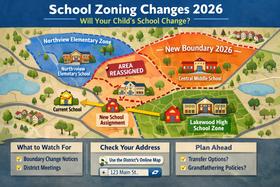
Learn more about zoning rules, how they impact schools and your child. This section offers information on the history of school zones, what they are, and how they work. Get information on who decides school boundaries and the impact those decisions have on the community.
GETTING STARTED
An overview of school designations, best practices for evaluating your options, and tips on choosing the best school for your child. Learn about Blue Ribbon, Vocational and Special Education schools. Get tips on finding the right school in a new neighborhood, city or state.
GRADING AND RANKING SCHOOLS
Explore the public school grading/ranking system, how it works and what it means. Get latest national rankings and read what critics of school grading have to say. Take a look at the nation’s top performing schools as ranked by U.S. News and Newsweek.
PUBLIC SCHOOL SAFETY
A comprehensive look at the safety of US public schools. Learn what schools are doing to combat gangs and drugs, prepare for natural disasters, and protect your children from predators. From web cameras to armed guards, see what tools public schools are employing to keep kids safe.
PUBLIC VS. PRIVATE SCHOOLS
A comparison of public and private schools, the pros and cons of each, and a look at the cost of getting a stellar education at both. Take a look at some of the most expensive schools, notable public school alumni, and learn more about “private” public schools.