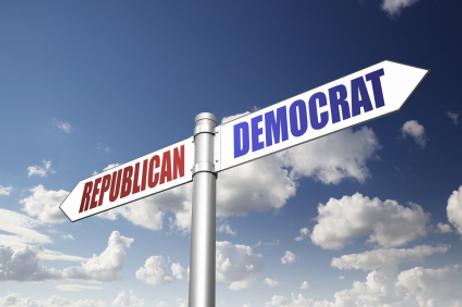
Presidential election season is once again in full swing, and yard signs, bumper stickers, campaign buttons, and social media posts all demonstrate Americans' support for their preferred candidates. Political expression remains an important part of civic participation, but as one high school student in Philadelphia discovered, expressing those views at school does not always go as planned. This student got more than she bargained for when she wore a pink Romney-Ryan T-shirt to school. She was publicly humiliated and harassed for her choice, not by fellow students, but by her own teacher.
The Samantha Pawlucy Story
Samantha Pawlucy was a sophomore at Charles Carroll High School in the Philadelphia area. Pawlucy decided to wear her Romney-Ryan T-shirt to class on a "dress-down" day when the shirt fit within the parameters of the school dress code. It was a daring thing to do in a community with one Republican for every six Democrats. However, Pawlucy had no idea just how traumatic the response to her attire would be.
Pawlucy's geometry teacher, Lynette Gaymon, called attention to Pawlucy's shirt during class. According to reports at the time, Gaymon told Pawlucy to remove the shirt. When Pawlucy refused, Gaymon compared wearing the shirt to coming to school wearing a Ku Klux Klan T-shirt. She explained that Charles Carroll High School was a "Democratic" school and then told Pawlucy to leave her classroom.
In this video, an attorney comes down hard on the teacher who was accused of bullying Samantha.
When Pawlucy refused to leave, Gaymon left the classroom and called in other teachers and students to point out Pawlucy's shirt. Gaymon encouraged others in the room to mock Pawlucy and even threatened to take a marker and cross out the names on the shirt. Pawlucy was traumatized by the event, and reports indicated that she remained home from school for the rest of that week out of fear. She later returned to school after Gaymon was transferred to another classroom.
"Just a Joke"
When Gaymon was questioned about the incident, the teacher referred to it as a "joke." However, Pawlucy's father, Richard Pawlucy, said that type of joke may be acceptable among adults, but his daughter was led to believe she had done something wrong. She also endured harassment from students after returning to school, possibly because Gaymon allegedly told other students that Pawlucy had gotten her into trouble "for making jokes."
"How can you be ignorant and be a teacher?" Richard Pawlucy asked the Philadelphia Inquirer. "She is being political. She is taking a side. She wants these students to support her point of view."
The incident also sparked a broader discussion about appropriate classroom conduct and respectful treatment of students with differing viewpoints. Schools today continue to emphasize creating respectful learning environments where students can express differing opinions without fear of intimidation or harassment. Parents interested in how schools address student conduct and expression may also find Public School Review's article on Free Speech Online? Court Offers Guidelines for Schools in Disciplining Students for Off-Campus, Online Speech helpful.
Within Her Rights
The Philadelphia School District told reporters that Pawlucy was within her rights to wear her political T-shirt to class. The district also verified that the shirt did not violate the school dress code in any way. As for Gaymon, the district stated that the teacher had been transferred to another classroom while the incident was investigated.
"The comments were of a political nature and also of a personal nature," district spokesman Fernando Gallard said. "We are looking into the comments and the conduct of the teacher."
In the meantime, the incident became national news after Richard Pawlucy discussed the matter on a local radio station. Individuals across the country quickly became interested in the case, and many called for elected officials and presidential campaigns to respond.
This video describes Samantha's return to school.
The controversy also prompted renewed discussion about political expression in public schools and how school districts should balance student rights with maintaining an orderly learning environment. Questions involving dress codes and student expression continue to arise today, particularly during election years. Readers interested in related issues may also enjoy Public School Review's article on School Uniforms Debate in 2026: Evidence, Costs, Outcomes.
What Does the Law Say?
When it comes to the law on such matters, the Constitution is fairly clear. Students' free speech is protected under the First Amendment. According to the Student Press Law Center, this generally means students are allowed to express their opinions without unnecessary government censorship. However, the law becomes somewhat more complicated in the environment of a public school classroom. Previous Supreme Court rulings continue to provide important guidelines that schools follow when balancing students' free speech rights with the need to maintain a safe and orderly learning environment.
The Tinker standard remains one of the most important Supreme Court rulings governing student speech in public schools. In December 1965, three siblings from the Tinker family decided to wear black armbands to school to protest the Vietnam War. The school learned of the plan and quickly adopted a no-armband policy because officials feared the protest would lead to disruption at school.
This video documents a teen being banned from school for wearing a MAGA hat.
The case, which began in federal court, eventually made its way to the Supreme Court. In the landmark case Tinker v. Des Moines Independent Community School District, the Supreme Court ruled in favor of the students' right to protest, stating that "It can hardly be argued that either students or teachers shed their constitutional rights to freedom of speech or expression at the schoolhouse gate." Additional information about the case is available through Oyez, a project of Cornell Law School, Justia, and Chicago-Kent College of Law.
The ruling stated simply that schools could not censor a student's freedom to express opinions merely because school officials disagreed with the message. However, schools do have the authority to restrict some forms of speech or behavior if there is sufficient evidence that the expression would cause a "substantial disruption" of the school environment or invade the rights of others. More recently, additional Supreme Court decisions have continued to clarify how these constitutional protections apply to both on-campus and certain off-campus student speech, particularly in cases involving social media and online expression.
Parents interested in how recent court decisions have affected student speech may also find Public School Review's article on Free Speech Online? Court Offers Guidelines for Schools in Disciplining Students for Off-Campus, Online Speech helpful.
In this case, the Philadelphia School District acknowledged that Pawlucy was acting within both her constitutional rights and school district policy when she chose to wear her political T-shirt to school. The teacher, on the other hand, faced an investigation into conduct that many believed amounted to ridicule and bullying of a student because of her political expression.
The case continues to be referenced in discussions about student rights, political expression, and the responsibility educators have to maintain viewpoint neutrality in public school classrooms. While schools have an obligation to provide safe and respectful learning environments, they must also protect students' constitutional rights regardless of the viewpoint being expressed.
As schools continue to navigate political expression during election seasons, administrators are encouraged to apply dress codes consistently, respond to disagreements respectfully, and ensure that students are not disciplined simply because they express lawful political opinions. Parents who have questions about school policies involving controversial topics may also find Public School Review's article on Public Schools and Guest Speakers: Do Parents Have Any Input? informative.
Ultimately, the principles established in Tinker continue to guide public schools more than 50 years later. While every situation depends on its specific facts, the fundamental balance between protecting free expression and maintaining an effective learning environment remains one of the cornerstones of student rights in America's public schools.