This article has been updated to reflect 2026 data and recent developments.
Stirring up a raging political, social, and economic debate, the issue of school vouchers is a hot topic among community leaders, members, and educators. School vouchers, which essentially work as a scholarship, allow parents to redirect the trajectory of educational funding. Instead of applying tax dollars to schools directly, vouchers allow tax money to be sent to individual families. With this approach, parents and families can choose how their educational tax money is spent, allowing students to attend private or public schools, as the tax money can be used to pay for private tuition costs.
For proponents, vouchers offer students in failing schools access to greater educational opportunities in private schools. On the other side of the debate, many experts assert that vouchers, in the larger spectrum, will cause far more harm than good. The debate has expanded considerably as more states have adopted vouchers, education savings accounts, and other forms of publicly supported school choice.
Vouchers and the Current State of Student Funding
While vouchers were still a relatively new concept and practice when this article was originally published, the Supreme Court of Wisconsin approved of its state’s voucher program in 1998, which supported family-ownership of educational tax funds. This verdict was appealed to the United States Supreme Court after its passing, but the judges of the Supreme Court voted not to hear the appeal; therefore, Wisconsin was able to continue its voucher approach to education.
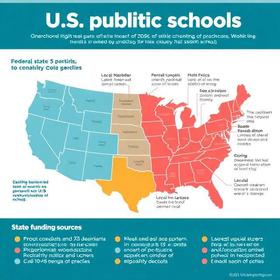
In 2026, the school choice landscape is considerably broader. The National Conference of State Legislatures reported in its 2025 policy scan that nine states, the District of Columbia, and Puerto Rico had established school voucher programs. Other states operate education savings accounts and related programs that provide families with public funds for eligible educational expenses.
This video from The Young Turks discusses Louisiana's voucher program.
Today, similar to Wisconsin, many states continually offer or consider vouchers as potential alternatives for school funding; as this issue comes to local and state-wide community forums, a heated debate seems inevitable. While families support increased ownership over the direction of their child’s educational choices, school leaders and financial planners often express dire concern over the potential harms of the voucher-based approach.
Public School Review's School Vouchers 2026: Updated Pros and Cons provides additional information for families considering how modern voucher programs work.
Vouchers and the Debate: What is the Conflict?
While many families believe that educational choices should be made by parents, school boards, and school officials, other educational experts assert that this approach is problematic. As Andrew J. Coulson from School Choices argued, government-run voucher programs have historically been criticized from two very different angles. The first body of criticism alleges that competitive markets are not well suited to the field of education and that school reform based on privatization, competition, and parental choice may create unintended consequences.
Essentially, as Coulson's argument reveals, some researchers believe that a voucher-based system would create a problematic educational dynamic, as schools would be run as businesses instead of educational institutions. Many people who argue with this lens desire to keep the business and financial focuses on schools separate from the instructional processes of learning. Ultimately, schools should serve to educate. They should not be distracted by concerns of advertising to students, and they should not feel pressured into pulling students and families into their particular school.
This video looks at who opposes school choice and why.
Adding to this first conflict, the second body of criticism states that government-funded scholarships would not create a genuinely free educational market, but instead could perpetuate dependence on government funding and regulation to the continued detriment of families. Aligning with this first critique, a free-market approach to education in America may instigate a new rise of government involvement in the educational practices of schools. In an era where there are governmental regulations and requirements on student performance and school instruction, some experts fear that vouchers will serve to enhance the government’s influence on schools and student learning.
The debate has become increasingly relevant as programs have expanded. The Education Commission of the States reported in January 2026 that at least 18 states had universal school choice programs.
Vouchers and Positive Choices
Bringing national attention to the voucher debate, ABC News reporter John Stossel examined the pros and cons of vouchers in his report “Stupid in America.” To examine vouchers, Stossel investigated schools in New York City and Washington, D.C., by using student-held cameras, as other states and large cities refused to allow ABC cameras into classrooms. When exploring the schools, Stossel reported that many of the public schools revealed classrooms of unmotivated and undisciplined students, as some teachers struggled to control the kids. Adding to this, some students reported that possession of drugs and drug use on school property was a common practice on their public school campus.
After encountering surprising and disappointing practices in the public schools that were reviewed and visited, a Gallup Poll study served as an indicator of the strife on public campuses. The original article cited Gallup findings showing widespread dissatisfaction with public education.
That figure requires updating for 2026. Gallup reported in September 2026 that 32% of Americans were satisfied with the quality of K-12 education nationally, while 67% were dissatisfied. Parents were substantially more positive about their own children's education, with 66% reporting satisfaction.
While many Americans are dissatisfied with public education nationally, research on the relationship between funding and student performance has become more nuanced. The original article argued that there was no strong link between funding and student performance and that simply increasing funding would not solve problems in public education. More recent research indicates that how money is spent, local circumstances, and the type of investment can matter. A 2025 Brookings Institution analysis noted a weak relationship between average state-level spending and outcomes while also acknowledging research finding causal benefits from increases in school spending.
As many parents feel that their child’s school fails to meet learning and development needs and requirements, Stossel and fellow community members assert that vouchers would allow for greater freedom of choice, allowing parents to choose the best school for their son or daughter, instead of being forced into a particular school based on one’s mere housing location. As Stossel articulated, vouchers could create a competitive market in which families have access to a wider variety of educational options.
In 2026, those options can extend beyond traditional vouchers. Depending on the state, families may encounter education savings accounts, charter schools, magnet schools, open enrollment programs, virtual schools, and other choice mechanisms. Public School Review's Public School Choice, Magnet Programs & Charter Options, What’s Best? provides additional context on several of these alternatives.
This video explains school choice.
Ultimately, while vouchers do offer a choice, the lingering questions of the implications of this redirection of funding remain. Although an individual child may benefit from vouchers, the debate continues to stir as experts question how schools and communities would be affected as a result.
As voucher and education savings account programs continue to evolve, families should examine the specific rules in their state, including eligibility, participating schools, allowable expenses, accountability requirements, and whether transportation or other costs are covered. The fundamental debate remains much as it was when this article was first published: supporters emphasize parental choice and access to alternatives, while critics continue to raise questions about public funding, accountability, educational outcomes, and the effects on public schools.