Overview of Public Schools

A comprehensive look at the U.S. public school system, including history, governing bodies, funding, and services. Compare private, public and charter schools. Learn more about Magnet school programs and get tips on choosing the right school for your child.

View the most popular articles in Overview of Public Schools:

Standardized Tests in 2025: What Parents & Educators Must Know

Updated
|
Standardized Tests in 2025: What Parents & Educators Must Know
Explore the 2025 landscape of standardized tests—policies, performance trends, and practical insights for students, parents, and schools.

Introduction

Standardized tests have long played a central role in U.S. K-12 and post-secondary education—used for everything from measuring student progress to informing school accountability and shaping college admissions. As we enter 2025, the landscape for standardized testing continues to shift in meaningful ways. From digital test delivery and evolving college admissions policies to declining student proficiency and renewed questions about equity, the changes matter deeply for parents, students, educators, and schools.

This article examines the current state of standardized testing in 2025: how policies have changed, what recent performance data show, how colleges are responding, and what practical steps families and schools can take to navigate this evolving terrain. In particular, we reference authoritative sources including the National Assessment of Educational Progress (NAEP) and federal education policy, and link to relevant resources—including one of our own reviews at Boarding School Review.

What We Mean by “Standardized Tests”

“Standardized tests” is a broad term that can refer to a variety of assessments administered under consistent conditions, with the goal of measuring student achievement or growth across different students, schools, or jurisdictions. In K-12 settings, this often includes state-level assessments (for example, in grades 3-8 and 11), diagnostic and interim assessments, and nationally-normed exams like the Scholastic Assessment Test (SAT) or the ACT in the college admissions context. These tests serve multiple functions: measuring what students know and can do, informing instruction, enabling comparisons across schools or states, supporting accountability systems, and guiding admission or placement decisions.

In 2025,
. . .read more

How Are U.S. Public Schools Doing in 2025?

Updated
|
How Are U.S. Public Schools Doing in 2025?
An updated 2025 look at U.S. public schools: enrollment, performance, equity, funding, and reforms shaping K–12 education today.

How Are Public Schools in the United States Actually Doing?

Introduction

Public schools educate nearly 90% of American children, making them a cornerstone of the nation’s future. Yet parents, policymakers, and educators often ask the same pressing question: How are U.S. public schools really doing? This 2025 update reviews the latest enrollment data, academic performance, funding challenges, and reforms shaping the K–12 landscape.

Enrollment and Demographics in 2025

According to the NCES Condition of Education 2025 report, total U.S. public school enrollment stands at 49.5 million students, continuing a slow decline since the pandemic peak of 2020. The student population is now:

  • 46% White
  • 28% Hispanic
  • 15% Black
  • 6% Asian
  • 5% Multiracial/Other

Nearly 15% of public school students receive special education services under IDEA, and 10.8% are English learners, highlighting the growing demand for inclusive and multilingual support.

Families comparing options often look at class sizes and student-teacher ratios. In 2025, the national average is 15:1, though states vary significantly. Parents interested in comparing public and private school ratios can explore detailed breakdowns on PublicSchoolReview.com.

Academic Performance and Accountability

The latest National Assessment of Educational Progress (NAEP) shows mixed results. While math and reading scores in 2025 improved slightly from their 2022 lows, they remain below pre-pandemic levels.

  • Fourth-grade math: modest rebound, but still 5 points lower than 2019.
  • Eighth-grade reading: stagnated, with large gaps between student groups.
  • STEM programs are expanding, with 42 states adopting updated computer science standards.

Graduation rates remain relatively strong: the national adjusted

. . .read more

Public Schools in a Minute

Updated
|
Public Schools in a Minute
Explore the diverse world of public schools in a minute! Our brief overview provides a snapshot of the educational landscape, school districts, curriculum, and more. Get a quick glance at the big picture of K-12 education.

History of Public Education

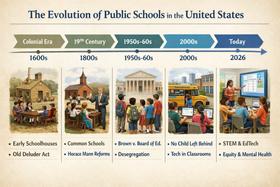
The first schools in colonial America were private. Public schools per se came much later on in the 19th century. A History of Public Schools offers a comprehensive overview of the subject.

Funding and Budgeting

U.S. public schools are funded by local property taxes supplemented by funding from state and private sources. 92% of public school funding comes from non-federal sources. An Overview of the Funding of Public Schools explains how the system works. Here are two examples of school district budgets to illustrate the disparity regarding funding between a large urban school district and a small rural school district.

Large School District (Example):

Total Annual Budget: $1.2 billion

Sources of Funding:

  • State Funding: $700 million
  • Local Property Taxes: $300 million
  • Federal Grants: $150 million
  • Other Sources (e.g., donations, grants): $50 million

Expenditure Breakdown:

  • Instructional Costs (teachers, textbooks, supplies): $600 million
  • Administrative Costs (salaries, facilities, utilities): $200 million
  • Student Support Services (counseling, special education): $150 million
  • Transportation: $50 million
  • Building Maintenance: $50 million
  • Extracurricular Activities: $30 million
  • Debt Service: $20 million
  • Reserves and Contingencies: $50 million

Compare this hypothetical budget with the actual 2023-24 budget of the Houston ISD.

Small School District (Example):

Total Annual Budget: $10 million

Sources of Funding:

  • State Funding: $5 million
  • Local Property Taxes: $3 million
  • Federal Grants: $1 million
  • Other Sources (e.g., donations, grants): $1 million

Expenditure Breakdown:

  • Instructional Costs (teachers, textbooks, supplies): $4 million
  • Administrative Costs (salaries, facilities, utilities): $1 million
  • Student Support Services (counseling, special education): $500,000
  • Transportation: $150,000
  • Building Maintenance: $200,000
  • Extracurricular Activities: $50,000
  • Debt Service: $100,000
  • Reserves and
. . .read more

Junior Reserve Officers Training Corps or JROTC

Updated
|
Junior Reserve Officers Training Corps or JROTC
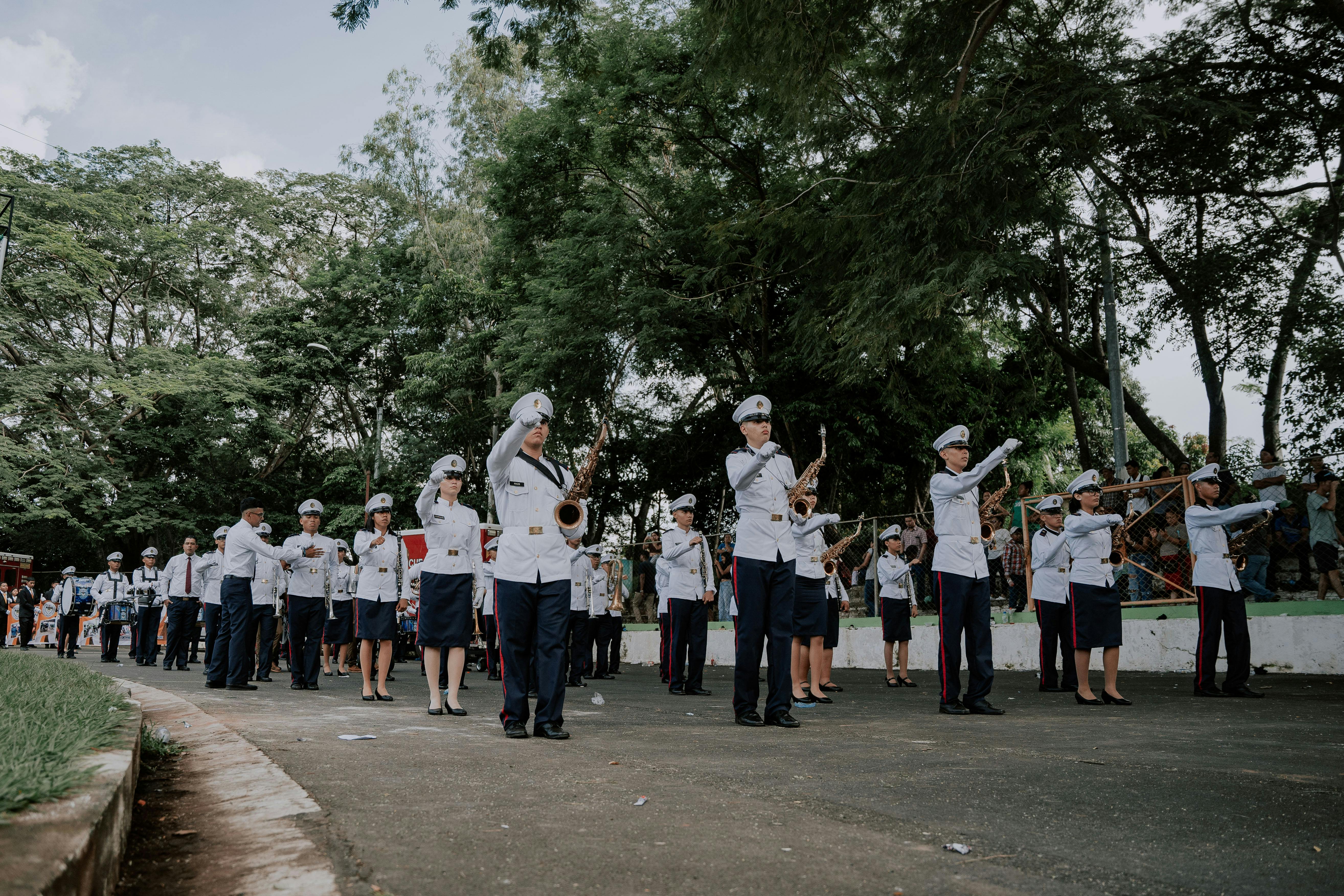
JROTC offers valuable lessons in leadership, character-building and citizenship. Here's a look at the various JROTC programs out there together with a look at the pros and cons of the program.
Wikimedia.commons.org, public domain/PH3 Victoria A. Tullock, USN

I was disappointed to read the story in the New York Times about abuse in an Army JROTC program. Why? Because I've always thought very highly of the program available in over 1700 public and private high schools. I will further disclaim that my eldest daughter was in the ROTC program at MIT while she was at Harvard. So, I know first-hand that it is well-run for the most part. The JROTC does an immense amount of good for young people at the high school level.

What is JROTC?

Congress established the JROTC or Junior Reserve Officers Training Corps in 1916. Each branch of the services has its own distinctive JROTC program. However, they all have the altruistic-sounding mission "To Motivate Young People to be Better Citizens."

The U.S. Army Junior Reserve Officers’ Training Corps (JROTC) is one of the largest character development and citizenship programs for youth in the world. Source: JROTC
  • Some people think that JROTC is a recruiting program for the military.
  • But it is not. Indeed, most JROTC participants do not join the military after graduating from high school.
  • Nor are they required to do so.
  • On the other hand, the college-level ROTC programs do require their participants to sign up for a tour of duty after graduating from college.
  • Simply put, the JROTC aims to develop leadership skills in its participants while ROTC prepares its members for the military.

This video explains

. . .read more

The Benefit of Foreign Language Programs

Updated
|
The Benefit of Foreign Language Programs
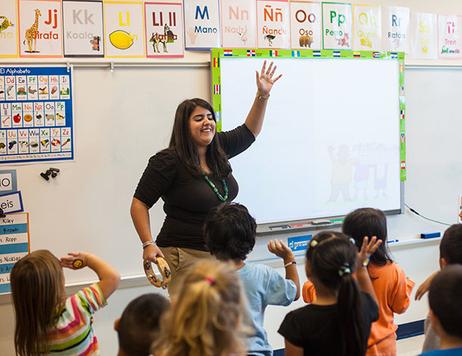
Discover why foreign language programs remain essential in 2026. Learn how bilingual education strengthens cognitive development, academic achievement, cultural awareness, and college and career readiness, while helping parents evaluate the quality of world language instruction in public schools.

Ask education experts, employers, and university leaders about the value of learning a second language, and the consensus is remarkably consistent: schools with strong foreign language programs provide students with academic, cognitive, and career advantages that extend far beyond the classroom.

Public schools that invest in world language education, whether through dual-language immersion programs, elementary language instruction, or comprehensive middle and high school offerings, often see benefits reflected in student achievement, cultural awareness, and college readiness. The strongest programs begin introducing languages during the elementary years and continue through high school, giving students sustained opportunities to develop proficiency while exploring the cultures associated with the languages they study.

While access to foreign language education has improved in some districts, availability remains uneven across the United States. Many schools continue to face teacher shortages, scheduling limitations, and budget constraints that make it difficult to offer comprehensive language programs. At the same time, interest in dual-language immersion programs and multilingual education continues to grow as families recognize the long-term academic and professional value of bilingualism.

According to the National Center for Education Statistics (NCES), schools continue expanding opportunities that prepare students for an increasingly interconnected world, although access to advanced academic programs, including world languages, still varies considerably by district and state.

This video outlines the benefits of learning a foreign language.

There are many reasons why schools, even at the elementary level, should incorporate foreign

. . .read more

Recent Articles

Can Your Child Get Into School Clubs and Activities?
Discover whether your child can access advertised school clubs and activities, including enrollment limits, tryouts, fees, transportation, scheduling conflicts, and essential questions parents should ask before choosing schools today.
Who Supervises Students When Their Teacher Is Out?
Discover who supervises students when regular teachers are absent, how schools arrange classroom coverage, what qualifications substitutes need, and which questions parents should ask about safety and learning continuity.
When the School Nurse Isn't There: Parent Guide
Learn what happens when school nurses are absent, how public schools handle medications and emergencies, and which essential questions parents should ask to protect their children's health and safety daily.