The History of Public Schools in the United States
Public schools have played a central role in shaping American society for more than three centuries. From their origins in colonial New England to the technology-enabled classrooms of 2026, public education has reflected the nation’s evolving values, economic needs, and social challenges. Understanding the history of public schools helps parents, educators, and policymakers better evaluate where the system stands today and where it may be headed next.
This updated overview traces the major eras of U.S. public education, highlighting key reforms, controversies, and milestones that continue to influence schools nationwide.
Colonial Foundations and Early Education Efforts
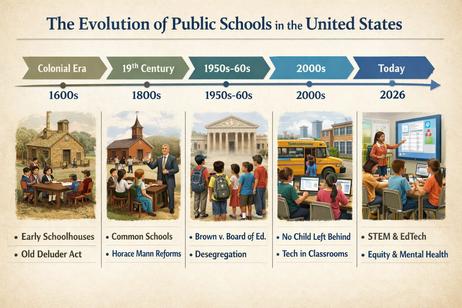
The roots of public schooling in America date back to the 1600s, when education was largely a local and religious endeavor. In Puritan New England, literacy was considered essential for reading the Bible, leading communities to establish early schools supported by town funds.
One of the most significant early laws was the Massachusetts Bay Colony’s 1647 “Old Deluder Satan Act,” which required towns to hire teachers and establish schools. While limited in scope and access, these early efforts laid the groundwork for the idea that communities shared responsibility for educating children.
Outside New England, education developed more unevenly. In the Southern colonies, private tutors and plantation-based instruction were common, while access for girls, Native Americans, and enslaved people was minimal or nonexistent.
The Common School Movement of the 19th Century
The modern concept of public schools took shape during the 1800s with the rise of the Common School Movement. Reformers argued that free, publicly funded schools were essential for democracy, social stability, and economic growth.
Horace Mann, often called the father of American public education, championed:
Universal access to free schooling
Professional training for teachers
Standardized curricula and school calendars
Public funding through local taxes
By the mid-19th century, many states had adopted compulsory attendance laws, and public schools expanded rapidly, especially in urban areas. These schools aimed to educate immigrant populations and promote shared civic values, though they often enforced cultural assimilation.
Segregation, Inequality, and Landmark Legal Changes
Despite growth, public schools were deeply unequal. Racial segregation became legally entrenched after the Supreme Court’s 1896 decision in Plessy v. Ferguson, which upheld “separate but equal” schooling. In practice, schools serving Black students were underfunded and overcrowded.
A turning point came in 1954 with Brown v. Board of Education, which declared segregated public schools unconstitutional. The ruling marked a historic step toward educational equity, though desegregation efforts faced resistance and uneven implementation for decades.
The federal government began playing a larger role in education during this era, particularly through civil rights enforcement and funding initiatives.
For a deeper look at how diversity shapes today’s classrooms, see Diversity in Public Schools.
Federal Involvement and the Expansion of Student Rights
The mid-20th century brought increased federal oversight and investment. The 1965 Elementary and Secondary Education Act significantly expanded funding for low-income students, establishing a precedent for targeted federal support.
During the 1970s, public schools also became central to disability rights. The Individuals with Disabilities Education Act guaranteed students with disabilities access to free and appropriate public education, transforming special education nationwide.
Other key developments included:
Title IX protections against gender discrimination
Expanded bilingual education programs
Greater recognition of student due process rights
These reforms reinforced the idea that public schools serve not only academic goals but also broader social and legal responsibilities.
Accountability and Reform in the Late 20th and Early 21st Centuries
By the 1980s and 1990s, concerns about academic performance and global competitiveness sparked a wave of accountability reforms. The 1983 report A Nation at Risk warned of declining educational standards and prompted calls for higher expectations.
This period introduced:
Standardized testing as a core accountability tool
School choice initiatives, including magnet and charter schools
Performance-based teacher evaluations
The No Child Left Behind Act of 2001 intensified federal oversight by tying funding to test results. While it highlighted achievement gaps, critics argued it narrowed curricula and overemphasized testing.
Families interested in how assessment shapes instruction may find value in Standardized Testing in Public Schools.
Public Schools in the Digital Age
Technology has reshaped public education over the past two decades. Classrooms increasingly rely on digital textbooks, online learning platforms, and data driven instruction. The COVID-19 pandemic accelerated these trends, forcing schools to adopt remote and hybrid models almost overnight. By 2026, many districts have retained elements of blended learning, using technology to personalize instruction and expand course offerings. According to the National Center for Education Statistics, the majority of public schools now integrate one-to-one devices or shared digital access as part of daily instruction.
However, the digital divide remains a challenge, particularly in rural and low-income communities, reinforcing long-standing equity concerns.
Current Trends and Challenges in 2026
Public schools today operate in a complex environment shaped by social change, political debate, and economic pressure. Several themes define the current era:
Teacher shortages and retention challenges
Increased focus on student mental health and well-being
Ongoing debates over curriculum content and parental involvement
Renewed attention to funding equity and school infrastructure
The U.S. Department of Education continues to emphasize evidence-based interventions, chronic absenteeism reduction, and post-pandemic academic recovery as national priorities.
Families evaluating school quality often consider factors beyond test scores. For guidance, see What Makes a Good Public School?.
How the History of Public Schools Shapes the Future
The history of public schools reveals a system constantly adapting to new expectations. Each era has expanded access while exposing new challenges. In 2026, discussions about artificial intelligence, career readiness, and civic education echo earlier debates about purpose and equity.
Educators and policymakers increasingly recognize that successful reform requires community engagement, sustained funding, and respect for local context. As the National Education Association notes, public schools remain one of the most direct expressions of democratic investment.
Parents comparing options may also explore how public schools differ from alternatives in Public vs. Private Schools.
A Living Institution
Public schools are not static institutions. They reflect the nation’s ideals, conflicts, and aspirations at any given moment. From one-room schoolhouses to digitally connected campuses, the history of public schools is a story of expansion, debate, and resilience.
As communities look ahead, understanding this history provides essential context. It reminds us that today’s challenges are part of a longer continuum and that thoughtful reform, grounded in past lessons, can help ensure public education continues to serve future generations effectively.