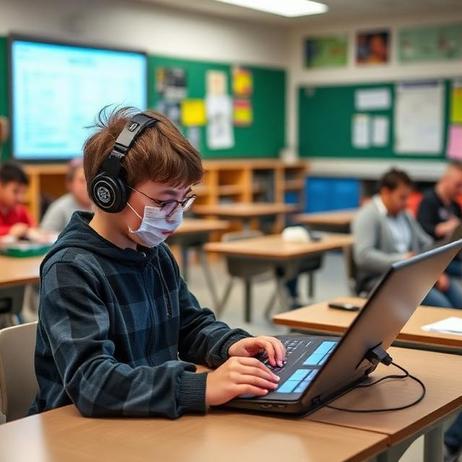
Artificial intelligence has moved from novelty to necessity in many classrooms. By 2026, students routinely use generative AI tools to brainstorm ideas, explain difficult concepts, summarize information, and receive instant feedback. At the same time, educators continue to wrestle with a difficult question: if AI is becoming a standard learning tool, should schools evaluate how students use it?
The concept of an "AI report card" is gaining attention among educators, policymakers, and school leaders. Rather than focusing solely on whether students used AI, proponents argue that schools should assess how responsibly, ethically, and effectively students incorporate AI into their learning.
For public schools, the debate is particularly important. As districts develop AI policies and digital literacy standards, many are beginning to view AI competency as a skill that deserves evaluation, much like research, writing, or technology literacy.
The question is no longer whether students will use AI. The question is whether schools should formally assess that use.
Why AI Use Has Become an Educational Issue
When ChatGPT and other generative AI tools first entered classrooms, many schools focused on detection and prevention. Educators worried about plagiarism, academic dishonesty, and students outsourcing their thinking.
Three years later, the conversation has evolved.
Recent guidance from UNESCO emphasizes a human-centered approach to AI in education, encouraging schools to teach students how to use AI responsibly rather than simply banning it. UNESCO's guidance highlights the importance of transparency, critical thinking, privacy awareness, and ethical use of AI systems in educational settings. UNESCO guidance on generative AI in education
At the same time, the OECD's 2026 Digital Education Outlook notes that generative AI is reshaping teaching and learning across education systems worldwide, making AI literacy an increasingly important competency for students. OECD Digital Education Outlook 2026
As AI becomes embedded in daily learning, some educators argue that ignoring student AI use is no longer realistic.
What Is an AI Report Card?
An AI report card does not necessarily mean grading students on how often they use ChatGPT or other tools.
Instead, it could evaluate skills such as:
- Understanding when AI is appropriate to use
- Verifying AI-generated information
- Properly citing AI assistance
- Protecting personal data and privacy
- Identifying bias and inaccuracies
- Demonstrating original thinking alongside AI support
- Using AI ethically and transparently
In many proposed models, AI evaluation would resemble digital citizenship assessments already used in schools.
The goal would not be to reward dependence on AI. Rather, it would measure students' ability to use AI responsibly.
The Case for Evaluating Student AI Use
AI Literacy Is Becoming a Core Skill
Schools have long adapted to new technologies.
Students are taught how to conduct internet research, evaluate sources, create presentations, and use productivity software. AI literacy may simply represent the next stage of digital literacy.
According to UNESCO's work on artificial intelligence in education, students need competencies that help them understand both the opportunities and risks associated with AI technologies. UNESCO AI in Education
An AI report card could help schools measure those competencies systematically.
Assessment Can Encourage Responsible Use
One challenge facing schools is that many students use AI without understanding its limitations.
Students often assume AI-generated information is accurate, unbiased, and complete. In reality, generative AI can produce errors, fabricated citations, and misleading conclusions.
By evaluating AI use, schools could encourage students to:
- Fact-check AI outputs
- Compare multiple sources
- Recognize hallucinations and inaccuracies
- Exercise critical thinking
In this model, assessment becomes a teaching tool rather than a policing mechanism.
Colleges and Employers Are Increasingly Expecting AI Skills
Higher education institutions and employers are rapidly integrating AI into workflows.
Students graduating from public schools in the coming years are likely to enter workplaces where AI-assisted writing, analysis, coding, and communication are commonplace.
An AI report card could provide evidence that students have developed practical AI literacy skills before graduation.
The Risks of AI Report Cards
Despite the potential benefits, many educators remain cautious.
Equity Concerns
Not all students have equal access to AI tools.
Some families can afford premium AI subscriptions and high-speed internet. Others rely on school-issued devices or limited connectivity.
If schools begin evaluating AI use, they must ensure that assessments do not reward students simply for having greater access to technology.
Public schools have spent years working to close digital divides. AI assessments must avoid creating new ones.
Privacy and Data Collection
Many AI platforms collect user data, prompts, and interactions.
Parents and educators have legitimate concerns about student privacy.
The U.S. Department of Education has repeatedly emphasized the importance of protecting student data when adopting educational technologies. Schools considering AI evaluation frameworks must carefully review privacy protections and vendor practices. U.S. Department of Education AI Resources
An AI report card should assess student understanding of privacy rather than require extensive monitoring of student AI activity.
Measuring AI Use Is Difficult
Traditional grading systems evaluate finished products.
AI use is more complicated.
Consider two students:
- Student A uses AI to generate an entire essay and submits it with minimal revision.
- Student B uses AI to brainstorm ideas but writes the essay independently.
The final essays might look similar, even though the learning process was very different.
Assessing AI use requires evaluating process, judgment, and decision-making, not just outcomes.
That can be difficult to measure consistently.
A Better Approach: Assessing AI Literacy, Not AI Usage
Many experts argue that schools should avoid grading AI usage itself.
Instead, they should assess AI literacy.
The difference is important.
| Assessing AI Usage | Assessing AI Literacy | |-------------------|----------------------| | Focuses on frequency of use | Focuses on quality of use | | Can encourage overuse | Encourages thoughtful use | | Difficult to verify | Easier to observe and document | | May create equity concerns | Can be taught across classrooms | | Emphasizes tools | Emphasizes skills |
This approach aligns with broader educational goals.
Schools do not grade students based on how often they use a calculator. They assess whether students understand mathematics and know when a calculator is appropriate.
The same principle could apply to AI.
What an AI Report Card Could Look Like
Rather than creating a separate report card category, schools might incorporate AI competencies into existing areas.
Sample Evaluation Framework
| Competency | Emerging | Proficient | Advanced | |--------------------|----------------------------------|----------------------------------|--------------------------------------------| | AI Transparency | Sometimes discloses AI use | Consistently discloses AI use | Explains how AI contributed to work | | Critical Evaluation | Accepts outputs without verification | Checks information for accuracy | Critically analyzes AI limitations | | Ethical Use | Limited understanding of guidelines | Follows school AI policies | Demonstrates leadership in responsible use | | Original Thinking | Relies heavily on AI suggestions | Uses AI as support tool | Integrates AI while maintaining strong independent thinking |
Such frameworks emphasize judgment rather than technology.
What Parents Should Know
For parents, the rise of AI report cards raises important questions.
Parents should ask:
- Does the school have a clear AI policy?
- How are students taught to evaluate AI-generated content?
- What safeguards protect student privacy?
- How does the school define acceptable AI use?
- Are students being taught critical thinking alongside AI skills?
The most effective programs treat AI as a tool that supports learning rather than replaces it.
Parents should be wary of approaches that focus solely on detection or punishment. Equally concerning are programs that encourage unrestricted AI use without guidance or oversight.
The Future of AI Assessment in Public Schools
The debate over AI report cards reflects a broader shift in education.
For decades, schools evaluated what students knew. Increasingly, they must also evaluate how students learn, research, and interact with technology.
As AI becomes a permanent part of education, schools will likely move toward assessing AI literacy alongside traditional academic skills. The challenge will be creating systems that promote ethical use, preserve student privacy, support equity, and maintain academic rigor.
The most promising path forward is not grading students for using artificial intelligence. It is helping them develop the judgment to use it well.
Conclusion
AI report cards are unlikely to become a universal feature of public education overnight. However, the underlying idea, evaluating students' ability to use artificial intelligence responsibly, is gaining momentum.
The strongest argument for AI report cards is not accountability. It is preparation.
Students entering college and the workforce will need far more than the ability to generate AI-produced content. They will need to question it, verify it, improve it, and use it ethically.
If schools choose to evaluate AI use, the focus should remain on critical thinking, transparency, and digital citizenship. In that sense, the future of AI report cards may be less about artificial intelligence itself and more about teaching students the human skills that matter most.