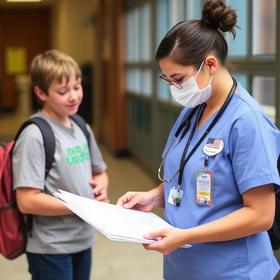

When a child develops a fever, experiences an allergic reaction, or gets injured during recess, parents expect someone at school to provide appropriate medical attention. However, not every public school has a full-time registered nurse available throughout the school day.
Some schools employ dedicated nurses, while others share nursing professionals across multiple campuses. In certain districts, trained administrative staff or health aides handle routine health office visits when a nurse is unavailable.
For families evaluating public schools in 2026, school nurse staffing deserves closer attention. The number of nurses serving a student population can influence how quickly health concerns are addressed, how chronic medical conditions are managed, and how prepared a school is for emergencies.
Understanding school nurse staffing standards, available health services, and potential warning signs can help parents determine whether their child's school provides adequate medical support.
Why School Nurse Staffing Matters
School nurses perform responsibilities that extend well beyond treating minor injuries or sending sick students home.
They assess student health concerns, coordinate care for children with chronic medical conditions, administer authorized medications, maintain health records, and support emergency preparedness.
The Centers for Disease Control and Prevention explains that school health services include preventive care, emergency response, and care coordination for students with conditions such as asthma, diabetes, and epilepsy.
For children who require daily medication or monitoring, access to appropriately trained healthcare personnel can be particularly important.
School nurses also communicate with parents, physicians, teachers, and administrators to help students participate safely in educational activities.
These responsibilities become more complicated when one nurse serves hundreds of students or travels between several schools.
The central question is not simply whether a school employs a nurse, but whether qualified medical assistance is consistently available when students need it.
How Many Students Should One School Nurse Serve?
Parents frequently encounter references to a traditional recommendation of one school nurse for every 750 students.
Although this ratio has appeared in historical school health discussions, it should not be treated as a universal staffing requirement or a sufficient standard for every school.
Modern recommendations increasingly emphasize student health needs rather than enrollment numbers alone.
The National Association of School Nurses identifies school nurse workload and essential staffing as important considerations in providing safe, equitable student care.
A school with 500 students, including numerous children with complex medical conditions, may require more nursing resources than a school of similar size with fewer intensive healthcare needs.
Other considerations include student ages, disability-related services, emergency response responsibilities, and whether the nurse works at one campus or several.
Consequently, a student-to-nurse ratio provides useful context but does not independently establish whether staffing is adequate.
Why Some Public Schools Share Nurses Across Campuses
School districts sometimes assign one registered nurse to multiple schools because of budget constraints, recruitment difficulties, or differences in student healthcare needs.
In these arrangements, the nurse may visit individual campuses on designated days while remaining available by telephone for consultations.
Routine responsibilities may be delegated to appropriately trained personnel when permitted by state law and district policy.
However, sharing nurses introduces practical challenges.
A nurse traveling between campuses cannot respond immediately to every medical situation. Schools must therefore establish clear procedures for handling emergencies when the nurse is elsewhere.
Parents should ask who supervises the health office, which staff members receive medical training, and how emergency services are contacted.
Public School Review's article on school-based health clinics, funding, billing, and student access examines another approach to delivering healthcare services within public schools.
School-based clinics may expand access to medical care, although they do not automatically replace the daily responsibilities of a school nurse.
What Happens When a Student Has a Chronic Medical Condition?
School nurse availability becomes especially important when students have conditions requiring regular monitoring or immediate medical intervention.
Children with diabetes may need assistance monitoring blood glucose or responding to emergencies. Students with severe allergies may require rapid access to epinephrine, while those with epilepsy may need individualized seizure response procedures.
Schools should establish appropriate health plans and ensure designated personnel understand their responsibilities.
Parents should provide current medical documentation, emergency contact information, and any necessary medication authorizations.
It is equally important to determine whether qualified personnel are available during recess, lunch periods, field trips, and extracurricular activities.
A written health plan offers limited protection if staff members responsible for implementing it are unavailable or inadequately trained.
Public School Review's article offering tips for parents of public school children with food allergies explains why communication with school nurses, teachers, and administrators is essential when managing potentially serious allergic reactions.
Although individual health conditions require different precautions, each demonstrates the importance of organized school health services.
How Nurse Shortages Can Affect Emergency Response
Medical emergencies can occur unexpectedly during ordinary school activities.
A student might experience breathing difficulties during physical education, suffer a serious playground injury, or develop symptoms of a severe allergic reaction.
Schools should have established emergency response procedures regardless of whether a registered nurse is physically present.
These procedures may include staff training in CPR, access to automated external defibrillators, medication protocols, and arrangements for contacting emergency medical services.
However, training requirements and authorization to administer medication vary by state.
Parents should not assume that every teacher or office employee can perform the same medical duties as a licensed nurse.
An effective emergency plan should identify who responds, what actions staff members are authorized to take, and how parents are notified.
What Do National Pediatric Experts Recommend?
In September 2026, the American Academy of Pediatrics reaffirmed its recommendation that every school has at least one full-time registered school nurse.
This recommendation reflects the growing complexity of student healthcare needs, including chronic illness management, mental health concerns, and emergency medical response.
The organization also emphasizes that school nurses help students remain healthy enough to attend classes and participate in learning.
However, professional recommendations do not automatically establish legal staffing requirements.
Individual states and districts may have different regulations governing school nurse employment, licensing, and responsibilities.
Parents should therefore distinguish between recommended staffing practices and the minimum requirements applicable to their particular school.
Questions Parents Should Ask About School Nurse Availability
Parents do not need medical expertise to evaluate whether their child's school has an appropriate health services plan.
During school visits or meetings with administrators, consider asking:
Is a registered nurse available throughout the entire school day?
How many students and campuses does each nurse serve?
Who responds to medical emergencies when the nurse is unavailable?
How are medications administered and chronic conditions monitored?
What procedures apply during field trips and after-school activities?
Parents should also ask whether the school regularly reviews staffing levels as student enrollment and healthcare needs change.
Public School Review's article on choosing a public school during budget uncertainty explains why families should investigate staffing stability, including whether nurses and other support professionals serve one campus or several.
A school should be able to explain its health office procedures clearly and identify the personnel responsible for student care.
What Parents Can Do If Nursing Coverage Seems Inadequate
If parents discover that a school has limited nursing coverage, the first step is to request clarification from administrators.
Ask how the school evaluates healthcare needs and whether staffing arrangements meet applicable state requirements.
Families can also raise concerns through parent organizations, district health services departments, or school board meetings.
When children have documented medical conditions, parents should work with healthcare providers and school personnel to establish individualized care arrangements.
It may also be appropriate to request a review of the school's emergency response procedures or medication administration policies.
Families can also review Public School Review's 2026–2027 public school immunization requirements to understand related school health documentation and compliance responsibilities.
The goal is to identify practical improvements that protect students rather than assume that every school without a full-time nurse is automatically unsafe.
Conclusion: Is Your Public School Providing Enough Nursing Support?
Determining whether your public school has enough nurses requires looking beyond enrollment figures.
Staffing levels, student medical needs, emergency preparedness, and the availability of qualified personnel all influence the quality of school health services.
Although national pediatric organizations recommend full-time nursing coverage at every school, actual staffing arrangements vary across districts.
Parents should understand who provides medical assistance, how emergencies are handled, and whether students with ongoing healthcare needs receive appropriate support.
Ultimately, adequate school nursing services help create a safer learning environment where children can receive necessary care without unnecessary interruptions to their education.