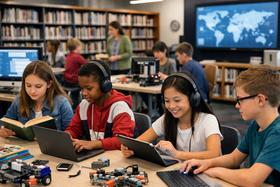
Cooperative learning is a successful teaching strategy in which small teams, each with students of different levels of ability, use a variety of learning activities to improve their understanding of a subject. Each member of a team is responsible not only for learning what is taught but also for helping teammates learn, thus creating an atmosphere of achievement. Students work through the assignment until all group members successfully understand and complete it.
As public schools continue emphasizing collaboration, communication, and problem-solving skills in 2026, cooperative learning remains one of the most effective instructional strategies for preparing students for both academic success and future careers. Research from the Institute of Education Sciences continues to support instructional practices that actively engage students in learning through discussion, teamwork, and shared responsibility.
Cooperative efforts result in participants striving for mutual benefit so that all group members:
- Gain from each other's efforts.
- Recognize that all group members share a common fate.
- Know that one's performance is influenced by both individual effort and the contributions of teammates.
- Feel proud and jointly celebrate when a group member is recognized for achievement.
This video illustrates the team model of learning.
Why Use Cooperative Learning?
Research has consistently shown that cooperative learning techniques:
- Promote student learning and academic achievement.
- Increase student retention.
- Enhance student satisfaction with the learning experience.
- Help students develop oral communication skills.
- Develop students' social and interpersonal skills.
- Promote student self-esteem.
- Encourage positive relationships among students from diverse backgrounds.
These benefits remain highly relevant today as schools focus not only on academic performance but also on developing collaboration and communication skills identified by organizations such as the Collaborative for Academic, Social, and Emotional Learning (CASEL) as essential for long-term student success.
Parents evaluating classroom instruction may also find How to Compare Public School Value Beyond Test Scores useful when looking beyond standardized assessment data to understand overall instructional quality.
The Five Elements of Cooperative Learning
It is only under certain conditions that cooperative efforts may be expected to be more productive than competitive and individualistic efforts.
Those conditions are:
Positive Interdependence (Sink or Swim Together)
Each group member's efforts are required and indispensable for group success. Each group member has a unique contribution to make to the joint effort because of his or her resources and responsibilities. Students understand that the success of the group depends upon every individual contributing their knowledge and effort.
-
Face-to-Face Interaction (Promote Each Other's Success)
Students strengthen learning by:
- Orally explaining how to solve problems.
- Teaching newly learned concepts to others.
- Checking one another's understanding.
- Discussing concepts being learned.
- Connecting present learning with previous knowledge.
These discussions encourage deeper understanding while strengthening communication skills.
-
Individual and Group Accountability (No Hitchhiking, No Social Loafing)
Keeping the size of the group small allows individual accountability to remain high.
Teachers can encourage accountability by:
- Giving an individual assessment to each student.
- Randomly calling on students to explain their group's work.
- Observing each group and recording participation.
- Assigning one student in each group the role of "checker," asking teammates to explain the reasoning behind group answers.
- Having students teach what they have learned to another student.
These strategies ensure that every student actively participates rather than relying on teammates to complete the work.
Parents interested in how schools encourage meaningful student participation may also enjoy reading Parental Involvement Is Key to Student Success, which explains how collaboration between schools and families strengthens student achievement.
-
Interpersonal and Small-Group Skills
Cooperative learning helps students develop important lifelong skills, including:
- Leadership
- Decision-making
- Trust-building
- Communication
- Conflict-management skills
These abilities prepare students for success not only in school but also in college, careers, and civic life.
-
Group Processing
Group members discuss how well they are achieving their goals and maintaining effective working relationships.
They:
- Describe which member actions are helpful and which are not.
- Make decisions about what behaviors should continue or change.
- Reflect on ways to improve future teamwork.
Reflection helps students become stronger collaborators while reinforcing shared responsibility for learning.
Schools that emphasize collaborative instructional strategies often create highly engaged learning environments. Families exploring different instructional approaches may also find The Pros and Cons of Tracking in Schools Today helpful when evaluating how schools group students to maximize learning opportunities.
Class Activities That Use Cooperative Learning
Most of these structures were developed by Dr. Spencer Kagan and his associates at Kagan Publishing and Professional Development. Their cooperative learning strategies continue to be widely used in classrooms today because they encourage active participation and shared responsibility for learning. Additional professional development resources are available at the Kagan Publishing website.
-
Jigsaw
Groups with five students are established. Each group member is assigned unique material to learn and then teach to the other members of the group. To prepare, students working on the same subsection meet in "expert groups" to determine what is most important and how best to teach it. After practicing together, the original groups reform and students teach one another. The Jigsaw strategy encourages accountability because every student contributes essential information needed by the rest of the group. This video explains the jigsaw method of learning.
-
Think-Pair-Share
Think-Pair-Share involves a simple three-step cooperative structure.
During the first step, students think independently about a question posed by the teacher. During the second step, they pair with a classmate to exchange ideas. During the third step, pairs share their responses with another pair, a small group, or the entire class. This structure encourages participation from every student while giving learners time to organize their thinking before speaking. This video explains Think Pair Share.
Three-Step Interview (Kagan)
Each member of a team chooses another member to be a partner. During the first step, students interview their partners by asking clarifying questions. During the second step, partners reverse roles. During the final step, each member shares their partner's responses with the rest of the team.
RoundRobin Brainstorming (Kagan)
The class is divided into small groups of four to six students with one person serving as the recorder. A question with multiple possible answers is presented, and students are given time to think individually before sharing their ideas one at a time in round-robin fashion. The recorder documents each response until time is called.
-
Three-Minute Review
Teachers stop at various points during a lecture or discussion and give teams three minutes to review what has been presented. During this time, students summarize key ideas, ask clarifying questions, identify areas of confusion, and answer one another's questions.
This simple strategy reinforces learning before new material is introduced and allows teachers to quickly identify misconceptions that may need additional explanation.
-
Numbered Heads Together (Kagan)
A team of four students is established, with each member assigned a number from one to four. The teacher asks a question, and the group works together to develop an answer so that every student is prepared to respond.
The teacher then calls a number at random, and the student with that number answers on behalf of the team. Because every student may be selected, all members are encouraged to participate actively and understand the material.
This strategy promotes both accountability and collaboration while ensuring that every student remains engaged throughout the lesson.
-
Team Pair Solo (Kagan)
Students first solve problems as a team, then with a partner, and finally on their own. This strategy is designed to motivate students to tackle and succeed with problems that may initially seem beyond their individual ability.
The approach is based on the principle of scaffolded learning. Students are often able to accomplish more with guidance than they can independently. By first working collaboratively, then with a partner, and finally individually, students gradually develop the confidence and skills needed to solve similar problems on their own.
Team Pair Solo is especially effective in mathematics, science, and other subjects that require sequential problem-solving and critical thinking.
-
Circle the Sage (Kagan)
The teacher begins by identifying students who possess special knowledge about a topic. For example, the teacher may ask who successfully solved a challenging mathematics problem, visited another country, or understands a particular scientific concept.
These students become the "sages" and spread out around the classroom. The remaining students gather around one of the sages to listen, ask questions, and take notes. Afterward, students return to their original teams and explain what they learned.
Because each student has learned from a different sage, teams compare information and discuss any differences they discovered. If disagreements arise, students work together to resolve them through additional discussion and teacher guidance.
Circle the Sage values student expertise while encouraging active listening, peer teaching, and collaborative learning.
-
Partners (Kagan)
The class is divided into teams of four. Partners move to one side of the room while each pair receives a different assignment to master before teaching it to the other pair.
Partners work together to learn the material and may consult with other students studying the same topic. Once they return to their teams, each pair teaches what they learned to their teammates. Students then quiz one another and review how effectively they both learned and taught the material.
Teaching classmates reinforces understanding while strengthening communication, leadership, and collaborative learning skills.
Why Cooperative Learning Still Matters in 2026
Although cooperative learning has been used successfully in classrooms for decades, its importance has only increased. Today's students are expected to collaborate, communicate effectively, solve complex problems, and work successfully with people from diverse backgrounds. These are skills that colleges and employers consistently identify as essential for future success.
Modern classrooms frequently combine traditional cooperative learning structures with digital collaboration tools, shared online workspaces, and project-based learning activities. Whether students are working face-to-face or using technology to collaborate remotely, the core principles of cooperative learning remain unchanged.
Research from the Institute of Education Sciences continues to support instructional approaches that actively engage students in discussion, collaboration, and meaningful problem-solving. Likewise, the Collaborative for Academic, Social, and Emotional Learning (CASEL) recognizes teamwork, communication, relationship-building, and responsible decision-making as important components of student success.
Families comparing different educational approaches may also benefit from reading Public vs Charter vs Magnet School: Which Is Best?, which explores how different school models approach classroom instruction and student engagement. Parents evaluating overall school quality may also find How to Choose a Public School for Your Child helpful when comparing instructional philosophies, academic programs, and school culture.
Conclusion
Cooperative learning continues to be one of the most effective teaching strategies available because it combines academic learning with the development of essential interpersonal skills. Rather than simply mastering subject content, students learn how to communicate, solve problems, lead discussions, manage conflict, and support one another's success.
Whether through Jigsaw, Think-Pair-Share, Three-Step Interview, Numbered Heads Together, Team Pair Solo, Circle the Sage, Partners, or the many other cooperative learning structures available today, students become active participants in the learning process instead of passive recipients of information.
As public schools continue preparing students for college, careers, and civic life, cooperative learning remains a valuable instructional approach that helps students build knowledge while developing the collaboration, communication, leadership, and critical-thinking skills needed in an increasingly interconnected world. Schools that successfully implement cooperative learning create classrooms where every student has the opportunity to contribute, learn from others, and achieve success together.