Evaluating Public Schools

This section provides tools to aid in finding the best public school option for your child. Compare private and public schools, explore school zoning issues, and delve into the public school grading and ranking system. Find information on the safest schools and what they are doing right.

View the most popular articles in Evaluating Public Schools:

Quality Counts: Grading The States - A Report From Education Week

Updated
|
Quality Counts: Grading The States - A Report From Education Week
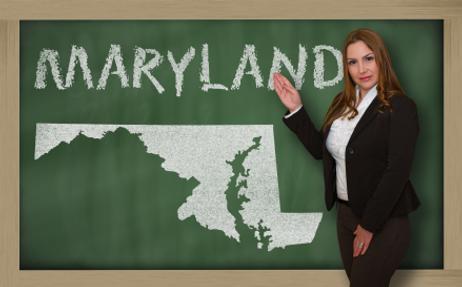
The results are in from Education Week’s annual public school rankings – and Maryland schools take the top spot for the fourth year in a row.
Maryland ranks at the top of the nation

While finals week may still be a long way off for most of the schools across the country, report cards are out for Education Week’s annual assessment of the nation’s schools state by state. For the fourth straight year, Maryland has claimed the top spot in the publication’s yearly ranking of school systems. However, with a top grade of B+, it is apparent that most of the country’s school districts still have a long way to go when it comes to providing the highest possible education to their students.

This video explains Education Week’s annual Quality Counts report card ranks state school systems based on everything from academics and funding to socioeconomic factors that can affect student success in school and later in life.

Quality Counts

Quality Counts is the name given to the most comprehensive assessment of the nation’s schools conducted by Education Week every year. According to Education Week’s website, the rigorous evaluation process provides an in-depth look at the state of public schools across the United States today. In light of the recent recession that resulted in big cuts in education spending for many states, as well as efforts by states to put the education pieces back in order during the slow economic recovery, this assessment becomes even more relevant in providing a snapshot of where the quality of education is heading.

“If the turbulence and waves of
. . .read more

Making Kids Safer: New CompStat Program Coming to CPS

Updated
|
Making Kids Safer: New CompStat Program Coming to CPS
Learn about a new program coming to Chicago Public Schools that will involve coordination between local police and school officials to keep kids safer in school and in the community.

Chicago Public Schools have taken more than their share of beatings in recent months, with the latest blow coming in the form of school closures of underperforming schools. Parents have protested the decision by school officials and Mayor Rahm Emanuel, saying children previously attending closed schools will now have to travel further and through dangerous neighborhoods to get to class every day. In hopes of countering some of those fears, Mayor Emanuel has followed the announcement of school closures with an announcement of a new safety program designed to keep kids safe in the classroom and the community.

The Unveiling of the New CompStat Safety Program

Last week, Mayor Emanuel unveiled the new safety program, which is modeled after the CompStat program first used in New York in 1994. According to a report in the Chicago Sun-Times, the program is designed to hold law enforcement officers accountable and accurately analyze crime statistics in surrounding neighborhoods at weekly meetings. While this program was originally developed to enhance law enforcement throughout New York City, the model can also be easily customized to the school and community environment.

Chicago Police Superintendent Garry McCarthy participated in the New York CompStat program for seven years while serving as head of the crime strategy for the NYPD. Now, he brings his experience to the Chicago program in hopes of uniting law enforcement, education officials, and religious leaders in weekly accountability and strategizing sessions to keep Chicago kids safer. Through

. . .read more

College Board AP District Honor Roll Includes Public Schools Coast to Coast

Updated
|
College Board AP District Honor Roll Includes Public Schools Coast to Coast
The article highlights the College Board's AP District Honor Roll, recognizing school districts across the U.S. for increasing AP course participation and improving exam scores. It discusses the criteria for selection, the benefits of AP programs, and the impact on college readiness and educational equity.

College Board recently released its latest AP District Honor Roll, which features 367 school districts nationwide. These schools have shown improvements not only in enrollment in AP classes but also in the number of students who scored high enough on the exams to obtain college credit. The school districts on this list have shown a commitment to helping high-achieving students attain academic success and have broadened the options of these students in pursuing postsecondary education.

What is Advanced Placement?

According to the College Board website, the Advanced Placement program was designed to allow students to earn college credit while still in high school. The program currently boasts more than 30 college-level course options that include a cumulative exam at the end that enables students to receive college credit for the material covered. The AP program also shows college admissions boards that students can handle the rigors of a postsecondary curriculum.

Advanced Placement courses are recognized by more than 3,800 colleges and universities worldwide. This ensures that the students participating in these high school courses have many options after graduation. The ability to earn college credit while in high school can present significant cost savings on higher education and allow students to complete their degree programs at a much faster rate.

This video explains Advanced Placement.

About the Advanced Placement Honor Roll

To qualify for the annual Advanced Placement Honor

. . .read more

Newsweek Ranks Top High Schools in the Country

Updated
|
Newsweek Ranks Top High Schools in the Country
Newsweek’s annual ranking of the best high schools in America has just been released based upon wider criteria than ever before. See where your high school stands and which campuses won the top accolades.

This article has been updated to reflect 2026 data and recent developments.

There is no doubt that many high schools across the country have faced serious challenges in light of the current economic slowdown. With shrinking budgets and the pressures of standardized test scores, schools have made difficult decisions regarding staffing, programs, and resources. With attention to these circumstances, the annual ranking conducted by Newsweek made some significant changes to take the challenges into account. With an expanded advisory board and a wider range of criteria, the publication recently released its ranking of the top 500 high schools in America. We’ll examine the criteria used by Newsweek to make their choices and highlight some of the schools that made the top of the list this year.

The Newsweek rankings discussed below are historical. In 2026, high school ranking methodologies have evolved and commonly incorporate standardized test performance, graduation rates, college readiness, student growth, and equity measures. Public School Review's Public School Rankings: Are They Accurate in 2026? provides current context on how school rankings are calculated and interpreted.

In this TEDTalk, Elizabeth Daves peels back the layers of the practice of ranking students, exposes the negative impact that ranking has on those being ranked, and calls for a shift in mindset about what learning, and teaching, means.

How Best to Rank High Schools?

When Newsweek embarked on this project for the current year,

. . .read more

Closing the Achievement Gap in Public Schools (2026 Update)

Updated
|
Closing the Achievement Gap in Public Schools (2026 Update)
Explore how public schools are closing the achievement gap with 2026 data, funding updates, and proven strategies improving student outcomes.

This article has been updated to reflect 2026 data and recent developments.

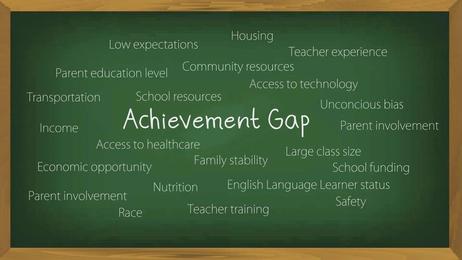
Closing the achievement gap remains one of the most urgent challenges in American public education. The term refers to persistent disparities in academic performance between groups of students, often defined by income level, race, ethnicity, and access to resources. While the gap has not disappeared, recent data and policy changes show measurable progress in several areas.

Public schools across the country are implementing targeted strategies that combine funding reforms, instructional innovation, and student support systems. These efforts, particularly since 2024, reflect a broader shift toward equity-driven education policy and data-informed decision-making.

Understanding the Achievement Gap in 2026

Recent data from the National Center for Education Statistics shows that achievement gaps in math and reading narrowed slightly between 2022 and 2024, particularly in early elementary grades, though disparities persist in middle and high school levels. Pandemic-related learning loss continues to influence outcomes, but recovery efforts are beginning to show results.

Key trends shaping the current landscape include:

  • Increased federal and state investment in high-need districts
  • Expanded access to early childhood education
  • Greater emphasis on data tracking and accountability
  • Growth in targeted intervention programs

According to the NCES, students in high-poverty schools are still significantly less likely to meet proficiency benchmarks, reinforcing the need for sustained intervention.

Key Strategies Public Schools Are Using

1. Expanding Early Childhood Education

One of the most widely supported strategies for closing the achievement gap is investing in early learning. Research consistently shows that

. . .read more

Recent Articles

When Your Child Gets a Teacher You Didn't Request
Learn what parents can do when a child is assigned to an unexpected teacher, including when to wait, communicate, document concerns, request support, and seek reassignment appropriately.
Before Accepting a Public School Seat: 15 Checks
Before accepting a public school seat, parents should verify enrollment terms, transportation, staffing, academics, safety, support services, schedules, attendance rules, extracurriculars, costs, and long-term placement details carefully.
Will This Public School Offer the Same Programs Next Year?
Learn how parents can determine whether public school programs will continue next year by checking budgets, enrollment, staffing, board documents, grants, course schedules, and district priorities before enrolling.

Evaluating Public Schools

SCHOOL ZONING
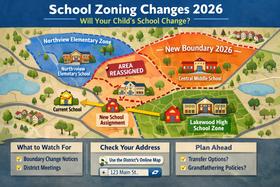
Learn more about zoning rules, how they impact schools and your child. This section offers information on the history of school zones, what they are, and how they work. Get information on who decides school boundaries and the impact those decisions have on the community.
GETTING STARTED
An overview of school designations, best practices for evaluating your options, and tips on choosing the best school for your child. Learn about Blue Ribbon, Vocational and Special Education schools. Get tips on finding the right school in a new neighborhood, city or state.
GRADING AND RANKING SCHOOLS
Explore the public school grading/ranking system, how it works and what it means. Get latest national rankings and read what critics of school grading have to say. Take a look at the nation’s top performing schools as ranked by U.S. News and Newsweek.
PUBLIC SCHOOL SAFETY
A comprehensive look at the safety of US public schools. Learn what schools are doing to combat gangs and drugs, prepare for natural disasters, and protect your children from predators. From web cameras to armed guards, see what tools public schools are employing to keep kids safe.
PUBLIC VS. PRIVATE SCHOOLS
A comparison of public and private schools, the pros and cons of each, and a look at the cost of getting a stellar education at both. Take a look at some of the most expensive schools, notable public school alumni, and learn more about “private” public schools.